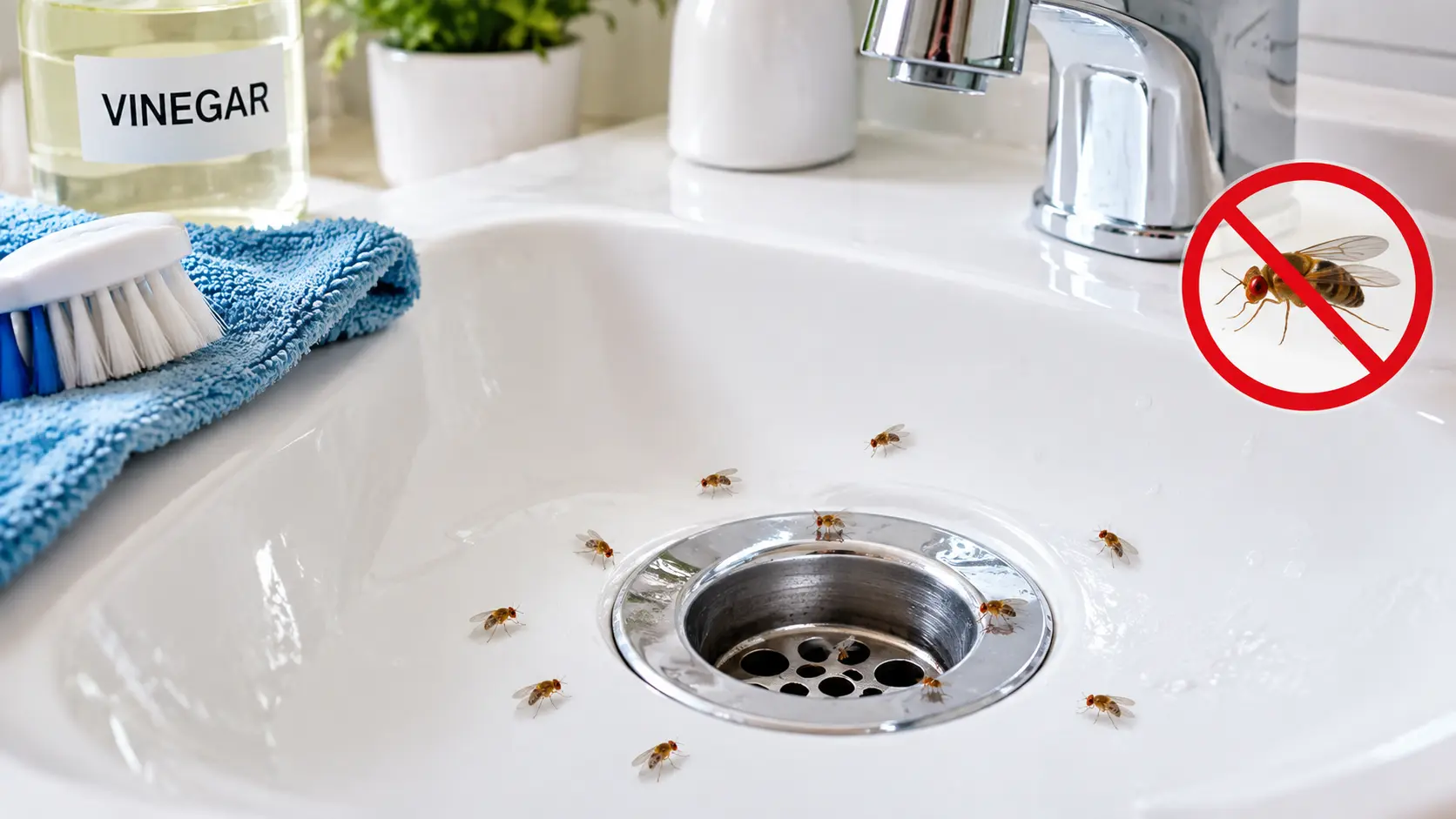
To kill fruit flies in a drain, first remove food and organic residue, then scrub the inside of the drain with a stiff drain brush to remove the buildup where flies can breed.
Flush the drain afterward and use a drain-safe enzyme or biological cleaner according to its label. Also remove other food sources and use a fruit fly trap to catch adults.
Key Takeaways
- Clean the breeding site, not just the adult flies you can see.
- Fruit flies can develop in moist drains containing fermenting organic material.
- Mechanical scrubbing is important because buildup can cling to the inside of drain pipes.
- An apple cider vinegar trap can reduce adult fruit flies while you clean the source.
- Never mix bleach with vinegar, ammonia, or other cleaners, because dangerous gases can form.
First, Make Sure They Are Actually Fruit Flies
Before treating the drain, identify what you are dealing with. Small flies around a sink are not automatically fruit flies.
Fruit Flies
True fruit flies, also called vinegar flies, are usually tiny, smooth-bodied flies that may be tan, yellowish, or brown and often have reddish eyes. They are strongly attracted to fermenting or overripe food, beverages, trash, and other moist organic material.
They can occur in drains, especially when food residue or fermenting material has accumulated inside the pipe.
Drain Flies
Drain flies, also called moth flies, are different insects. They are usually small, dark, and fuzzy-looking, with wings that give them a moth-like appearance.
They commonly develop in the slimy organic material that accumulates inside drains.
If your flies look fuzzy and tend to rest on the wall near a sink, shower, or floor drain, you may actually have drain flies rather than fruit flies.
Phorid Flies
Phorid flies are another possibility. They can breed in decaying organic material and may sometimes be associated with drains or plumbing problems. If cleaning the obvious food sources and drains does not solve a persistent infestation, a hidden breeding site may need to be investigated.
Tip: The cleaning strategy for fruit flies and drain flies overlaps because both can be associated with organic buildup, but correct identification becomes important if the infestation keeps returning.
How to Confirm the Drain Is the Source
If you see flies around your sink, don’t automatically assume they are coming from the drain.
Fruit flies can also come from:
- Overripe fruit
- Vegetables
- Recycling containers
- Trash cans
- Compost
- Sweet beverage spills
- Fermenting food
- Garbage disposals
Penn State Extension notes that fruit flies may occur in drains, garbage disposals, trash containers, and other moist areas containing fermenting material.
One simple way to investigate a suspicious drain is to cover the opening overnight with clear plastic film or another temporary covering. If flies appear at the drain opening or become trapped against the covering, the drain deserves closer attention. Extension guidance also recommends covering drains to help identify the source.
How to Kill Fruit Flies in Drain: Step-by-Step
1. Remove Food and Organic Residue
Start outside the drain.
Throw away overripe fruit and vegetables, rinse recycling containers, empty food waste, and wipe up sticky or fermented spills.
This matters because eliminating the breeding source is the foundation of fruit fly control.
Then remove the drain stopper or strainer if possible and clean away visible food particles.
If you have a garbage disposal, pay special attention to food residue around the opening and splash guard.
2. Scrub Inside the Drain
This is one of the most important steps.
Use a suitable stiff drain brush or pipe brush to scrub the accessible inside surfaces of the drain. The goal is to physically remove the slimy organic material where flies may lay eggs and larvae develop.
Simply pouring a liquid down the drain may not remove material stuck to the pipe walls. Extension guidance specifically recommends mechanical cleaning for accumulated organic material.
Work carefully and follow the instructions for your particular plumbing fixture.
3. Flush the Drain
After physically removing as much buildup as possible, flush the drain with hot water.
Very hot or boiling water can provide short-term control of larvae on exposed organic material, but it should not be treated as a replacement for cleaning the buildup itself.
If you have plastic plumbing, a garbage disposal, or a fixture manufacturer’s temperature restrictions, follow the manufacturer’s guidance rather than assuming boiling water is appropriate.
The goal is to wash loosened residue away after cleaning.
4. Use an Appropriate Enzyme or Biological Drain Treatment
For stubborn organic buildup, a drain-safe enzyme or biological treatment may be useful.
Some extension guidance describes bacterial drain treatments that break down organic matter in drains.
Choose a product specifically intended for the type of drain you are treating and follow its label directions. Do not combine different drain chemicals.
An enzyme or biological treatment works as a complement to physical cleaning—it should not be viewed as a substitute for removing heavy buildup with a brush.
5. Clean the Garbage Disposal
If the affected sink has a garbage disposal, clean it as part of the same treatment.
Food particles can remain around the disposal opening and other accessible areas, providing another source of organic material.
Clean the components according to the disposal manufacturer’s instructions. Remove visible food residue and keep the surrounding sink area clean and dry.
Important: If you clean only the sink drain while leaving another nearby organic source untouched, the flies may continue to appear.
6. Trap the Adult Flies
While you’re treating the drain, you can reduce the adult population with an apple cider vinegar trap.
Put a small amount of apple cider vinegar in a shallow container and add a drop of dish soap. The vinegar attracts fruit flies, while the soap reduces the liquid’s surface tension and makes it harder for the flies to escape. Extension guidance recommends cider-vinegar traps as one option for adult fruit fly control.
Place the trap near—but not inside—the affected sink.
Remember that the trap handles adult flies. It does not replace drain cleaning if the drain is the breeding site.
7. Repeat and Monitor
Don’t be discouraged if you still see a few flies immediately after cleaning.
If eggs or immature flies remain elsewhere, adults may continue appearing for a while. Continue monitoring the treated drain and check other potential breeding sites.
If the infestation does not decline after thorough cleaning, investigate other drains, garbage disposals, trash, recycling, compost, plumbing leaks, and other moist organic areas.
Does Vinegar or Baking Soda Kill Fruit Flies in Drains?
Vinegar can be useful for attracting adult fruit flies in a trap, but pouring vinegar into the drain is not the same thing as eliminating the breeding site.
Likewise, the familiar baking-soda-and-vinegar combination produces visible fizzing, but fizz alone should not be considered a reliable replacement for physically removing drain buildup.
Virginia Cooperative Extension notes that vinegar poured into a drain is not very effective against drain flies because it may kill some larvae on the surface without penetrating the accumulated organic material. Mechanical cleaning is more important.
So, if you want to use vinegar, the more useful role is generally an adult fruit fly trap, while the drain itself should be physically cleaned.
Will Bleach Kill Fruit Flies in the Drain?
Bleach is not the best solution for a drain infestation, and repeatedly pouring bleach into a drain is not a substitute for removing organic buildup.
More importantly, never mix bleach with vinegar, ammonia, acidic cleaners, or other household chemicals. Poison Control warns that mixing bleach with acids can produce chlorine gas, while bleach and ammonia can produce chloramine gas.
If you have already used a chemical drain product, check its label before using anything else in the drain.
Important: Never mix household cleaning chemicals just to create a stronger drain treatment.
Why Fruit Flies Keep Coming Back
If flies disappear for a day or two and then return, one of these problems may still exist:
- The drain still contains organic buildup.
- Another drain is serving as a breeding site.
- Food or beverage residue is attracting adults.
- The garbage disposal has leftover organic material.
- Trash or recycling has not been thoroughly cleaned.
- There is a hidden plumbing or moisture problem.
- The insects are actually drain flies or phorid flies rather than fruit flies.
A persistent infestation means you should look for the source, not simply use more traps.
Extension experts emphasize that killing adult flies alone does not eliminate an infestation when immature stages are still developing at a breeding site.
How to Prevent Fruit Flies in Drains
Once the infestation is under control, prevention is mostly about keeping organic material and moisture from accumulating.
Kitchen
- Refrigerate or discard overripe produce.
- Rinse recycling containers.
- Empty food waste regularly.
- Clean spills promptly.
- Keep the sink and drain area clean.
- Clean the garbage disposal according to its instructions.
- Periodically inspect the drain for buildup.
Bathroom
- Keep sink and shower drains clean.
- Fix leaking faucets and pipes.
- Do not allow standing water to remain unnecessarily.
- Run water periodically through rarely used drains.
Alabama Extension recommends keeping drains and sink or shower components clean, fixing leaks, unclogging drains, and running water through unused drains regularly as part of drain-fly prevention.
Frequently Asked Questions
Can fruit flies live in a sink drain?
Yes. Fruit flies can develop in drains when fermenting or decaying organic material is present. However, small flies around a drain may also be drain flies or phorid flies, so identification matters.
Will boiling water kill fruit flies in a drain?
Hot or boiling water can kill some exposed larvae and provide short-term control, but it does not reliably remove the organic buildup where flies breed. Scrubbing the drain is more important for eliminating the breeding material.
Does vinegar kill fruit flies in drains?
Vinegar may affect some exposed insects, but pouring vinegar into a drain is not a reliable way to eliminate an infestation. Use physical cleaning to remove buildup, and consider vinegar with dish soap as a trap for adult fruit flies.
Will bleach kill fruit flies in the drain?
Bleach may kill some insects on contact, but it does not reliably remove the organic material supporting an infestation. Never mix bleach with vinegar, ammonia, or other household cleaners because dangerous gases can form.
How long does it take to get rid of fruit flies in a drain?
The timeline varies depending on the breeding source and how thoroughly it is removed. You should look for a declining number of adult flies after the source is cleaned. If flies continue appearing, investigate additional breeding sites rather than simply repeating adult traps.
Why do I still have fruit flies after cleaning my drain?
The drain may not be the only breeding site. Check fruit bowls, trash, recycling, compost, garbage disposals, other drains, spills, and hidden moist organic material. If the insects persist despite thorough sanitation, consider whether they are actually drain or phorid flies.
Conclusion
The most effective way to kill fruit flies in a drain is to eliminate the place where they can breed. Start by removing food sources, then scrub the accessible drain surfaces to remove organic buildup.
Flush away the loosened residue, use a suitable drain-safe biological or enzyme treatment if needed, and set an apple cider vinegar trap to reduce adult fruit flies.
If the flies keep returning, don’t simply keep pouring products down the drain.
Check other drains and hidden sources and make sure you’re dealing with fruit flies rather than drain flies or phorid flies. Removing the breeding site is the key to breaking the cycle.

I’m Moja Spark, the creator of Punvio.com, where I share my expert-level humor, puns, and witty content to make your day brighter and more fun. Explore creative wordplay, clever jokes, and laugh-worthy ideas crafted by me