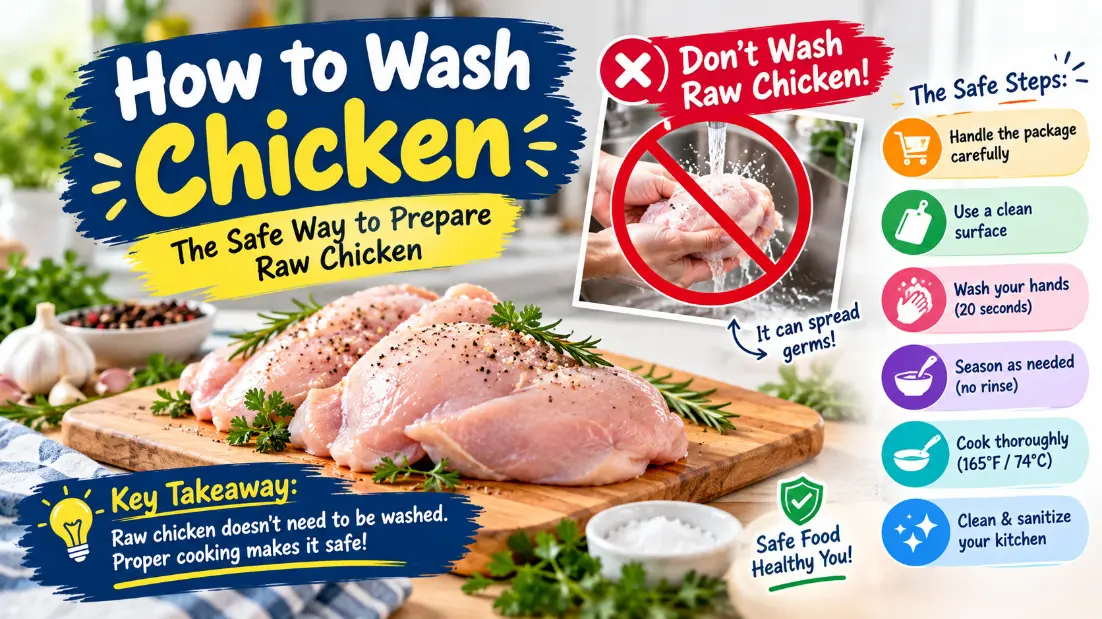
If you’ve ever searched for how to wash chicken, you may have seen advice telling you to rinse raw chicken under cold water, use lemon or vinegar, or wash it before seasoning.
But there’s an important food-safety detail to know: raw chicken generally does not need to be washed before cooking.
According to the CDC and USDA, washing raw chicken can spread harmful germs through splashing water onto your sink, countertops, utensils, and other foods. Cooking chicken properly is what makes it safe to eat.
So, instead of focusing on how to rinse chicken, the safer approach is to learn how to handle, prepare, clean, and cook chicken properly.
⚡ Quick Answer: Should You Wash Chicken Before Cooking?
No. You generally should not wash raw chicken before cooking it.
Raw chicken can contain harmful germs such as Salmonella, Campylobacter, and Clostridium perfringens. Washing the chicken doesn’t reliably remove these germs and can spread them around your kitchen.
The safer process is:
- 🍗 Take the chicken from its packaging.
- 🧻 If needed, handle it carefully without splashing.
- 🔪 Prepare it on a clean surface.
- 🧼 Wash your hands after handling raw chicken.
- 🍳 Cook chicken thoroughly.
- 🌡️ Use a food thermometer and cook poultry to 165°F (74°C) internally.
─────────────────────────
💡 KEY TAKEAWAY: Raw chicken is ready to cook and does not need to be washed first. Proper cooking kills harmful germs more reliably than rinsing.
─────────────────────────
🧼 Why You Shouldn’t Wash Raw Chicken
It may seem logical that rinsing chicken would make it cleaner.
However, the main problem is cross-contamination.
When water hits raw chicken, tiny droplets can splash onto nearby surfaces. Those droplets may carry bacteria from the raw chicken to your:
- Kitchen sink
- Countertops
- Cutting boards
- Utensils
- Hands
- Other foods
The USDA specifically warns that washing poultry can spread bacteria to other foods, utensils, and surfaces.
🦠 Washing Doesn’t Make Chicken Safe
Some people wash chicken because they believe they’re removing bacteria.
But harmful bacteria can be tightly attached to raw poultry, so washing isn’t a reliable way to eliminate them.
Cooking is what destroys harmful bacteria when chicken reaches a safe internal temperature.
💦 Why Water Can Make the Problem Worse
The water itself doesn’t necessarily make the chicken safer.
Instead, splashing can move contaminated juices around your kitchen.
That’s why food-safety guidance focuses on clean, separate, cook, and chill rather than washing raw poultry.
─────────────────────────
📌 IMPORTANT: Washing raw chicken can spread germs instead of removing the food-safety risk.
─────────────────────────
🍗 How to Prepare Chicken Without Washing It
You can safely prepare raw chicken without rinsing it.
1. 🛍️ Handle the Package Carefully
Keep raw chicken separate from foods that won’t be cooked, such as:
- Fresh vegetables
- Salad ingredients
- Bread
- Fruit
- Ready-to-eat foods
When storing chicken, keep it sealed or securely wrapped so raw juices don’t leak onto other foods.
2. 🔪 Use a Clean Cutting Board
Place raw chicken on a clean cutting board or preparation surface.
If possible, use a separate cutting board for raw meat and poultry and another for foods that won’t be cooked.
This helps reduce cross-contamination.
3. 🧂 Season the Chicken
You can season raw chicken directly with your preferred spices, herbs, marinades, or other ingredients.
There’s no need to rinse the chicken first.
4. 🧼 Wash Your Hands
Wash your hands with soap and water for at least 20 seconds after handling raw chicken.
Handwashing is one of the most important ways to prevent germs from spreading around your kitchen.
5. 🍳 Cook It Thoroughly
Cook chicken until the thickest part reaches 165°F (74°C).
A food thermometer is the most reliable way to check.
─────────────────────────
💡 TIP: Don’t judge chicken’s safety by color alone. A food thermometer gives you a much more reliable indication that poultry has reached a safe temperature.
─────────────────────────
🍋 Does Lemon or Vinegar Clean Raw Chicken?
Lemon juice and vinegar are commonly mentioned in traditional chicken-cleaning methods.
However, using lemon juice, vinegar, salt, or similar ingredients does not replace proper cooking as the food-safety step.
The important distinction is:
Cleaning for taste or preparation is not the same as making raw chicken microbiologically safe.
If you use an acidic ingredient as part of a marinade or recipe, treat the chicken as raw until it has been properly cooked.
🧂 What About Salt?
Salt may be used in recipes, brines, or seasoning, but it shouldn’t be considered a substitute for cooking.
The same principle applies to other ingredients people sometimes use to “clean” chicken.
─────────────────────────
📌 KEY TAKEAWAY: Lemon, vinegar, salt, and similar ingredients should not be treated as a substitute for safe cooking.
─────────────────────────
🧻 What If Your Chicken Looks Wet or Has Liquid on It?
Packaged chicken can naturally have liquid or moisture inside the package.
That doesn’t automatically mean you need to wash it.
Here’s What to Do
- Open the package carefully.
- Avoid splashing the liquid.
- Keep the chicken away from ready-to-eat foods.
- Dispose of the packaging appropriately.
- Wash your hands after handling the raw chicken.
- Clean surfaces that come into contact with raw chicken.
If you want a drier surface for browning, you can carefully pat the chicken dry with a disposable paper towel rather than rinsing it.
🧽 How to Clean Your Kitchen After Handling Chicken
Even when you don’t wash the chicken, raw poultry can still leave germs on surfaces that it touches.
That’s why kitchen cleanup matters.
🧼 Clean These Areas
After preparing raw chicken, pay attention to:
- Cutting boards
- Knives
- Plates
- Countertops
- Utensils
- Sink areas
- Faucet handles if touched with contaminated hands
Wash food-contact items with hot, soapy water after preparing raw chicken.
🧴 What About Sanitizing?
If raw chicken or its juices have contaminated a surface, cleaning should be followed by appropriate sanitizing according to the product’s directions.
The CDC recommends cleaning and sanitizing surfaces that have been contaminated by raw meat, poultry, or their juices.
─────────────────────────
💡 IMPORTANT: Don’t forget the sink. If raw chicken juices get into or around the sink, clean and sanitize the affected area thoroughly.
─────────────────────────
🌡️ How to Cook Chicken Safely
The most important step after preparation is proper cooking.
🎯 Safe Internal Temperature
Chicken and other poultry should reach an internal temperature of:
165°F (74°C)
Use a food thermometer to check the thickest part of the chicken.
🍗 Why Temperature Matters
Raw or undercooked poultry can contain harmful germs that can cause foodborne illness.
Cooking chicken thoroughly helps destroy these germs.
You can’t reliably determine whether chicken is safe simply by washing it, looking at it, or relying only on its texture.
A thermometer provides a much better safety check.
📊 Chicken Safety Checklist
| Step | What to Do |
|---|---|
| 🛍️ Store | Keep raw chicken sealed and separate |
| 🔪 Prepare | Use a clean surface |
| 🧼 Hands | Wash for at least 20 seconds |
| 💧 Wash chicken? | Generally, no |
| 🍳 Cook | Cook thoroughly |
| 🌡️ Temperature | 165°F (74°C) |
| 🧽 Cleanup | Wash and sanitize contaminated surfaces |
─────────────────────────
💡 KEY TAKEAWAY: The goal isn’t to make raw chicken safe by washing it. The goal is to prevent cross-contamination and cook it to a safe internal temperature.
─────────────────────────
🚨 What If You Already Washed the Chicken?
Don’t panic.
If you’ve already rinsed raw chicken, the important thing is to clean the surrounding area thoroughly and prevent the water or chicken juices from spreading to other foods.
Do These Steps
- 🧼 Wash your hands with soap and water.
- 🧽 Clean the sink and nearby surfaces.
- 🧴 Sanitize contaminated surfaces appropriately.
- 🍽️ Wash utensils and cutting boards that contacted raw chicken.
- 🥗 Check that ready-to-eat foods weren’t splashed or contaminated.
- 🍳 Cook the chicken thoroughly to 165°F (74°C).
If raw chicken juices splashed onto nearby foods that won’t be cooked, don’t assume those foods are safe simply because the chicken itself will be cooked.
─────────────────────────
⚠️ IMPORTANT: If you wash chicken, the biggest concern is cross-contamination. Clean and sanitize the sink and surrounding surfaces immediately.
─────────────────────────
❓ FAQs About How to Wash Chicken
Should you wash chicken before cooking?
No. Raw chicken is ready to cook and generally does not need to be washed. Washing can spread harmful germs around your kitchen.
How do you clean chicken before cooking?
The safest approach is not to wash raw chicken. Instead, handle it carefully, prevent cross-contamination, season it as needed, and cook it thoroughly.
Can you wash chicken with water?
You can physically rinse chicken with water, but food-safety authorities do not recommend doing so because splashing can spread germs around your kitchen.
Should you wash chicken with lemon?
Lemon can be used as part of a recipe or marinade, but it should not be considered a way to make raw chicken safe.
Proper cooking remains the critical food-safety step.
Should you wash chicken with vinegar?
Vinegar may be used in recipes, but washing chicken with vinegar isn’t a substitute for proper cooking or safe food handling.
How long should you wash chicken?
You generally shouldn’t wash raw chicken at all.
Instead, focus on preventing cross-contamination and cooking the chicken to 165°F (74°C).
How do you remove the smell from raw chicken?
If raw chicken has an unusual or unpleasant odor, don’t try to remove it by washing.
Check the package, storage conditions, and expiration/use-by information. If you suspect the chicken has spoiled, it’s safer not to use it.
Can washing chicken make you sick?
Washing raw chicken can increase the risk of spreading harmful germs around your kitchen through splashing and cross-contamination.
What temperature should chicken reach?
Chicken and other poultry should reach an internal temperature of 165°F (74°C) as measured with a food thermometer.
What should you do after touching raw chicken?
Wash your hands with soap and water for at least 20 seconds and clean any utensils, cutting boards, plates, and surfaces that contacted the raw chicken.
─────────────────────────
💡 QUICK ANSWER: You don’t need to wash raw chicken before cooking. Handle it carefully, prevent cross-contamination, clean your hands and surfaces, and cook poultry to 165°F (74°C).
─────────────────────────
📝 Conclusion
So, how do you wash chicken safely?
The safest answer is that you generally shouldn’t wash raw chicken before cooking it.
Rinsing can spread harmful germs around your kitchen without making the chicken reliably safer.
Instead, keep raw chicken separate from ready-to-eat foods, use clean preparation surfaces, wash your hands after handling it, clean contaminated utensils and surfaces, and cook chicken to 165°F (74°C).
If you’ve already washed your chicken, don’t panic. Focus on cleaning and sanitizing the sink and surrounding surfaces and preventing cross-contamination.
─────────────────────────
⚠️ IMPORTANT: The safest way to prepare chicken is to skip the rinse and focus on proper handling, hygiene, and thorough cooking.
────────────────────────

I’m Moja Spark, the creator of Punvio.com, where I share my expert-level humor, puns, and witty content to make your day brighter and more fun. Explore creative wordplay, clever jokes, and laugh-worthy ideas crafted by me