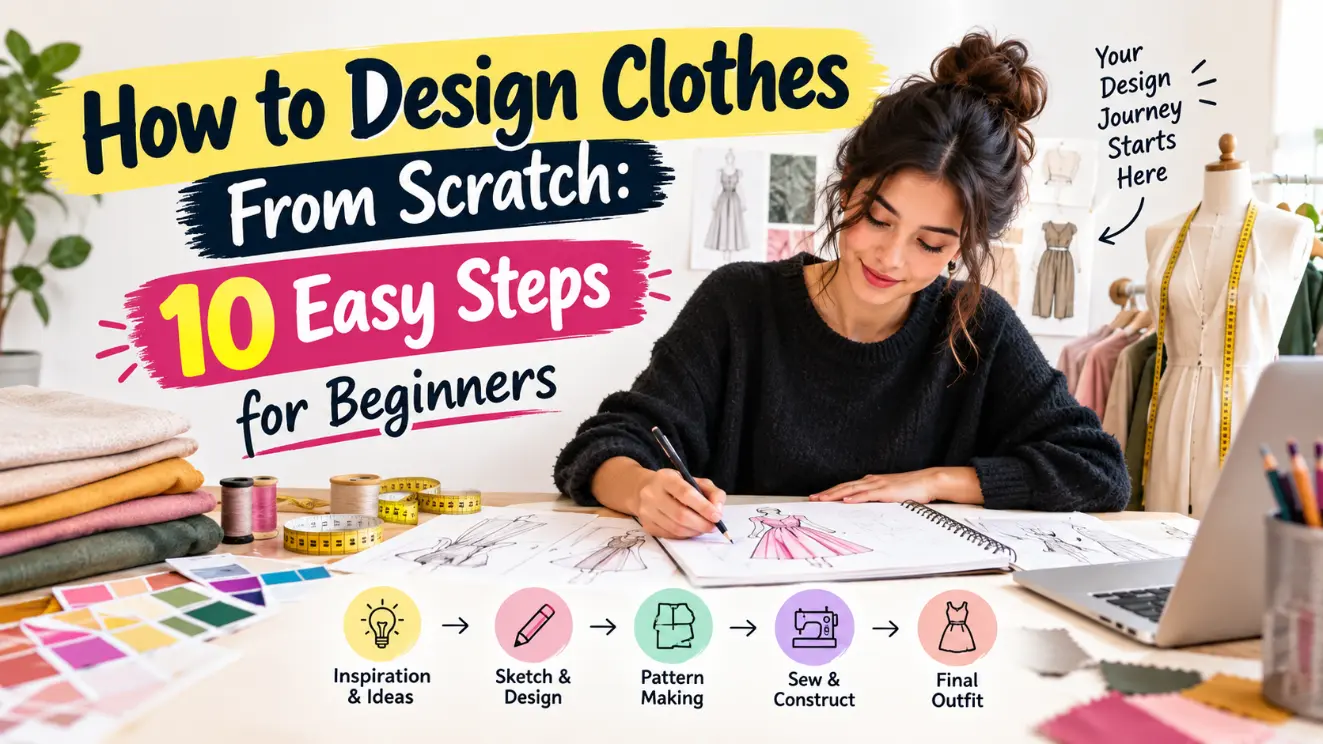
Designing clothes is a creative process that combines fashion, creativity, fabric knowledge, pattern making, fitting, and sewing.
If you want to design clothes for yourself, start a fashion brand, build a portfolio, or simply learn fashion design as a hobby, understanding the complete clothing design process can help you turn an idea into a finished garment.
This beginner-friendly guide explains how to design clothes from scratch, from finding inspiration and creating sketches to choosing fabric, making patterns, creating a toile, fitting the garment, and finishing the final piece.
🎨 Understanding Fashion Design as a Discipline
Fashion design is more than simply drawing attractive clothing. A successful clothing design needs to consider appearance, function, fabric, fit, construction, comfort, and the person who will wear it.
There are several ways to enter fashion design. Some people study fashion formally at a college or university, while others learn through online courses, books, practice, sewing classes, or personal projects.
Different Paths Into Fashion Design
You do not need to follow one specific path to begin designing clothes.
You can learn through:
- Fashion design courses
- Sewing classes
- Pattern-making lessons
- Online tutorials
- Books and fashion resources
- Personal experimentation
- Working with experienced designers or makers
The most important part is developing practical skills and learning how different parts of the design process work together.
Key Roles in the Fashion Industry
Fashion design can involve many different roles, including:
- Fashion designers
- Pattern makers
- Textile designers
- Technical designers
- Sample makers
- Fit specialists
- Product developers
- Fashion illustrators
A designer may perform several of these roles, especially when starting independently.
Designing for Yourself vs. Designing for Others
Designing clothes for yourself gives you more freedom because you already understand the person wearing the garment.
Designing for other people requires additional research. You need to understand their needs, preferences, body measurements, lifestyle, budget, and expectations.
💡 KEY TAKEAWAY
There is no single path into fashion design. Start with the skills and learning method that best match your goals and resources.
🔍 Research and Inspiration
Before you begin sketching, spend time researching. Inspiration can come from almost anywhere, including architecture, nature, art, history, music, street style, culture, photography, and existing fashion.
Where to Find Inspiration
Useful sources of inspiration include:
- Fashion magazines
- Museums and exhibitions
- Art and photography
- Nature
- Architecture
- Historical clothing
- Street fashion
- Textiles
- Travel
- Everyday objects
- Online fashion platforms
The goal is not to copy an existing garment. Instead, look for ideas that can influence your own design direction.
Building a Mood Board
A mood board helps bring your ideas together visually.
You can include:
- Colors
- Fabrics
- Shapes
- Textures
- Images
- Patterns
- Architectural references
- Photographs
- Words or phrases
A strong mood board can help you maintain a consistent visual direction throughout the design process.
Trend Forecasting Basics
Understanding current and emerging fashion trends can help you recognize what is happening in the industry.
However, trends do not have to control your entire design.
Use trends as research while developing a design identity that feels appropriate for your concept and audience.
Avoiding Derivative Design
Inspiration and copying are not the same thing.
Study references carefully, identify what attracts you about them, and then transform those ideas into something with your own design perspective.
💡 TIP
Use several different inspiration sources instead of relying on a single fashion reference. This can help your final concept feel more original.
🎯 Define Your Aesthetic and Target Customer
Before developing a collection or individual garment, define what you want your design to communicate.
Your aesthetic might be:
- Minimalist
- Romantic
- Sporty
- Classic
- Avant-garde
- Casual
- Streetwear
- Elegant
- Vintage-inspired
Your aesthetic influences your choices throughout the design process.
Identify Your Design Point of View
Ask yourself:
- What type of clothing do I want to create?
- What makes my designs different?
- Which colors and silhouettes appeal to me?
- What kind of mood should my clothing create?
- What values should my designs communicate?
These questions can help establish a consistent design direction.
Understand Your Target Customer
Your target customer affects almost every design decision.
Consider:
- Age
- Lifestyle
- Location
- Budget
- Clothing preferences
- Body shape and fit preferences
- Shopping habits
- Practical needs
Create a Customer Persona
A customer persona is a simple description of your ideal customer.
For example, you might describe:
Age: 25–35
Lifestyle: Professional and active
Style: Minimal and modern
Budget: Mid-range
Needs: Comfortable clothing suitable for work and everyday life
This gives you a clearer person to design for instead of trying to appeal to everyone.
How Audience Shapes Design Decisions
Your target audience can influence:
- Fabric
- Colors
- Silhouette
- Fit
- Price
- Details
- Construction
- Functionality
🎯 KEY TAKEAWAY
Knowing your aesthetic and target customer early helps guide decisions about fabric, fit, color, price, and overall design direction.
✏️ The Design Process: From Concept to Sketch
Once you understand your inspiration and audience, you can begin developing the actual garment.
Brainstorming and Concept Development
Start with multiple ideas rather than trying to create the perfect design immediately.
Make rough sketches and explore:
- Silhouettes
- Necklines
- Sleeves
- Pockets
- Closures
- Lengths
- Proportions
- Decorative details
Then select the strongest ideas for further development.
Flat Sketches vs. Fashion Illustration
A fashion illustration communicates how a garment might look on a person.
A flat sketch, on the other hand, shows the garment more technically and helps communicate construction details.
Both can be useful, but they serve different purposes.
Technical Flats
Technical flats are simplified drawings that show the front and back of a garment.
They can communicate details such as:
- Seams
- Pockets
- Buttons
- Zippers
- Stitching
- Panels
- Necklines
- Sleeve construction
Technical drawings become especially important when working with manufacturers or sample makers.
Digital Tools vs. Hand Sketching
You can design clothes using traditional drawing materials or digital tools.
Hand sketching can be useful for quickly developing ideas, while digital tools can make editing, organizing, and presenting designs easier.
✏️ TIP
Don’t worry about making your first sketches perfect. Use early sketches to explore ideas and gradually refine the strongest concept.
🧵 Understanding Fabric
Fabric can completely change how a garment looks and behaves.
A design that works beautifully in one fabric may not work in another.
Fiber Types and Properties
Common fiber categories include:
- Cotton
- Linen
- Wool
- Silk
- Polyester
- Nylon
- Rayon
- Blended fibers
Each material has different characteristics related to weight, texture, durability, stretch, breathability, and care.
Woven vs. Knit Fabrics
Woven fabrics are created by interlacing yarns, while knitted fabrics are constructed using loops.
This difference affects:
- Stretch
- Structure
- Drape
- Comfort
- Construction methods
Drape, Weight, Stretch, and Breathability
When choosing fabric, consider:
Drape: How the fabric falls around the body.
Weight: How heavy or light the material feels.
Stretch: How much the fabric can expand and recover.
Breathability: How easily air can move through the fabric.
These characteristics should match the garment design.
Sourcing Fabric
You can source fabric from:
- Local fabric stores
- Textile suppliers
- Online fabric retailers
- Wholesale suppliers
- Deadstock suppliers
- Specialty textile markets
Always consider the fabric’s behavior before purchasing a large quantity.
🧵 KEY TAKEAWAY
Choose fabric based on how it behaves, not just how it looks. Drape, weight, stretch, and breathability can significantly affect the final garment.
🎨 Color and Print
Color is one of the first things people notice about clothing.
A thoughtful color strategy can make individual garments and entire collections feel more cohesive.
Color Theory
Basic color theory can help you understand:
- Complementary colors
- Analogous colors
- Neutral colors
- Warm colors
- Cool colors
- Contrast
- Saturation
You do not need to follow color theory rigidly, but understanding it gives you more control over your choices.
Seasonal Color Palettes
If you are designing a collection, consider creating a coordinated color palette.
A palette might include:
- Main colors
- Supporting colors
- Accent colors
- Neutral colors
Print Design and Placement
Prints can be used across an entire garment or placed strategically on specific areas.
Consider how print placement affects:
- Body proportions
- Visual balance
- Garment construction
- Pattern matching
- Overall appearance
Textile Designers and Print Houses
For larger projects, designers may work with textile designers or print houses to develop custom patterns.
🎨 TIP
Choose your color palette early when designing a collection so different garments can work together visually.
📐 Pattern-Making Fundamentals
Pattern making converts your design idea into pieces that can be cut from fabric.
A beautiful sketch still needs an accurate pattern to become a wearable garment.
What Is a Pattern and Why Does It Matter?
A pattern is a template used to cut fabric pieces.
Patterns can include pieces for:
- Front bodice
- Back bodice
- Sleeves
- Collars
- Skirts
- Pants
- Pockets
- Waistbands
Drafting From Measurements
Pattern drafting can be based on body measurements.
Accurate measurements are essential because small errors can affect the final fit.
Modifying Commercial Patterns
Beginners can also start with commercial patterns and modify them to create different designs.
You can adjust:
- Length
- Neckline
- Sleeves
- Waist
- Fit
- Shape
- Details
Draping
Draping involves shaping fabric directly on a dress form.
It can be especially useful for developing three-dimensional designs and understanding how fabric behaves around the body.
Digital Pattern-Making Software
Digital pattern-making tools can help designers:
- Draft patterns
- Make adjustments
- Store versions
- Grade sizes
- Prepare production files
Grading
Grading is the process of creating different sizes from a base pattern.
It becomes important when producing garments for multiple body sizes.
📐 KEY TAKEAWAY
Pattern-making turns a creative idea into practical fabric pieces. Accuracy at this stage has a major impact on the final fit.
🧪 Sampling: The Toile or Muslin Process
Do not immediately cut your final fabric when developing a new design.
A toile, sometimes called a muslin, is a test version of the garment.
Why Not Cut Final Fabric First?
A toile allows you to discover problems before using expensive or difficult-to-work-with fabric.
You can check:
- Shape
- Proportion
- Fit
- Length
- Construction
- Movement
- Placement of details
Choosing Muslin or Test Fabric
The test fabric should generally behave similarly enough to your final fabric for the sample to provide useful information.
What to Evaluate
Try the toile on the intended wearer or an appropriate fit model.
Look for:
- Pulling
- Wrinkles
- Tight areas
- Loose areas
- Uneven hems
- Incorrect proportions
- Restricted movement
Common First-Sample Issues and Fixes
Common problems can often be corrected by adjusting the pattern.
You may need to:
- Add or remove length
- Change seam placement
- Adjust width
- Modify darts
- Alter sleeves
- Change the neckline
- Reshape the garment
⚠️ IMPORTANT
A toile is a test version, not the final garment. Use it to identify fit and construction problems before using your final fabric.
👗 Fitting and Refinement
Fitting is one of the most important stages of clothing design.
Even a technically correct pattern may need adjustments when tested on an actual body.
Dress Form vs. Real Body
A dress form can be useful for developing and checking garments, but a real body provides information about:
- Movement
- Comfort
- Body shape
- Fabric behavior
- Real-world fit
Common Fit Issues
Look for:
- Horizontal wrinkles
- Vertical pulling
- Excess fabric
- Tightness
- Uneven shoulders
- Sleeve problems
- Waist issues
- Hem imbalance
Iterative Refinement
Do not expect the first sample to be perfect.
A professional design process often involves:
Design → Pattern → Sample → Fit → Adjust → Sample Again
Fit Models
A fit model can provide useful information about how a garment fits and moves on the body.
👗 TIP
Treat fitting as an ongoing process. Small adjustments and repeated testing can gradually improve the final result.
🪡 Construction: Sewing the Final Garment
After the pattern and fit have been refined, you can construct the final garment.
Core Sewing Skills
Important skills include:
- Seam construction
- Seam finishing
- Zipper installation
- Buttonholes
- Hemming
- Gathering
- Interfacing
- Lining
- Pressing
Sewing Machine vs. Hand Finishing
A sewing machine can handle much of the main construction, while hand sewing can be useful for finishing and delicate details.
Interfacing, Lining, and Structural Elements
Depending on the garment, you may need:
- Interfacing
- Lining
- Boning
- Shoulder pads
- Elastic
- Stabilizers
These components can affect structure, comfort, and durability.
Quality Construction
Pay attention to:
- Straight stitching
- Seam consistency
- Secure closures
- Clean finishing
- Pressing
- Reinforcement in high-stress areas
🪡 KEY TAKEAWAY
Good construction depends on both technical sewing skills and attention to small finishing details.
✨ Finishing Touches and Details
Small details can strongly influence how a garment looks and feels.
Trims, Topstitching, and Embellishments
Depending on the design, you may use:
- Decorative stitching
- Lace
- Piping
- Embroidery
- Beads
- Appliqué
- Ribbons
- Decorative trims
Buttons, Zippers, and Hardware
Closures should match the garment’s design and function.
Consider:
- Size
- Weight
- Color
- Material
- Placement
- Durability
Labels and Branding
If you are creating clothing for a brand, labels can communicate:
- Brand identity
- Size
- Care instructions
- Fabric information
- Origin
Details Signal Quality
Consistent stitching, clean seams, properly installed closures, and thoughtful finishing can make a significant difference.
✨ TIP
Inspect small details before considering a garment finished. Consistent stitching, hardware, labels, and trims can make the final piece feel more polished.
🔄 Getting Feedback and Iterating
Feedback can help identify problems that you may not notice yourself.
Wear and Test the Garment
If possible, wear the garment and move naturally.
Try:
- Sitting
- Walking
- Reaching
- Bending
- Moving your arms
This can reveal comfort and construction issues.
Gather Outside Feedback
Ask people to comment on specific areas such as:
- Fit
- Comfort
- Appearance
- Function
- Color
- Proportion
Specific questions usually produce more useful feedback than simply asking whether someone likes the garment.
Create a Feedback Loop
A strong process looks like:
Design → Test → Collect Feedback → Adjust → Test Again
Learn From What Doesn’t Work
Mistakes can provide valuable information.
Keep notes about what worked and what did not so future designs become more efficient.
🔄 KEY TAKEAWAY
Feedback isn’t just for finished garments. Use it throughout the design process to catch problems earlier and improve future designs.
💻 Tools and Software for Modern Designers
Modern designers can use both traditional and digital tools.
Sketching Tools
These may include:
- Pencils
- Markers
- Fashion illustration paper
- Drawing tablets
- Digital illustration applications
Pattern-Making Software
Digital pattern tools can help with:
- Drafting
- Editing
- Grading
- Measurement adjustments
- Technical documentation
3D Garment Visualization
3D fashion software can allow designers to visualize garments digitally before producing physical samples.
Portfolio and Presentation Tools
Digital presentation tools can help organize:
- Mood boards
- Sketches
- Technical flats
- Fabric information
- Final garments
- Design development
💻 TIP
Start with simple tools and upgrade your software as your skills and project requirements grow.
📁 Building a Design Portfolio
A portfolio demonstrates how you think and work as a designer.
What to Include
Depending on your purpose, include:
- Mood boards
- Research
- Initial sketches
- Design development
- Technical flats
- Fabric choices
- Pattern development
- Toile photographs
- Fitting adjustments
- Final garments
Create a Cohesive Collection
If showing multiple designs, make sure they have a visual connection.
This can come from:
- Color
- Fabric
- Silhouette
- Theme
- Customer
- Design details
School, Job, or Personal Brand
Your portfolio should match your goal.
A school portfolio may focus heavily on creative development and experimentation.
A professional portfolio may place more emphasis on technical skills, finished garments, production knowledge, and commercial awareness.
📁 KEY TAKEAWAY
A strong portfolio should show not only your finished garments but also how you think, design, solve problems, and develop ideas.
💼 Turning Clothing Design Into a Business
Designing clothes for yourself is different from creating garments for commercial production.
If you decide to build a clothing business, additional skills become important.
Producing at Scale
Large-scale production requires careful planning around:
- Quantities
- Sizes
- Materials
- Quality control
- Production schedules
- Manufacturing
Working With Manufacturers
Manufacturers may need detailed information about the garment before production begins.
Creating Tech Packs
A tech pack can contain information such as:
- Technical drawings
- Measurements
- Materials
- Construction details
- Stitching information
- Labels
- Packaging requirements
Pricing and Costing
Commercial clothing needs to account for costs such as:
- Fabric
- Trims
- Labor
- Packaging
- Manufacturing
- Shipping
- Marketing
- Overhead
Selling Your Designs
Possible sales channels include:
- Your own website
- Online marketplaces
- Physical stores
- Pop-up events
- Social media
- Wholesale
💼 IMPORTANT
Designing a garment and running a clothing business require different skills. Production, costing, manufacturing, and selling become important once you move beyond personal projects.
🚫 Common Mistakes New Clothing Designers Make
Beginners can avoid many problems by understanding common mistakes.
Skipping the Sampling Stage
Going directly from sketch to final fabric can result in wasted materials and poor fit.
Not Defining a Customer
Trying to design for everyone can make a collection feel unfocused.
Underestimating Fabric
A fabric may look beautiful but behave differently than expected.
Always consider its properties before committing to the design.
Ignoring Fit
A garment can look great on paper but still feel uncomfortable or unbalanced when worn.
Avoiding Feedback
Without testing and feedback, problems may remain unnoticed until very late in the process.
🚫 KEY TAKEAWAY
Most beginner mistakes happen when designers rush the process. Sampling, fitting, fabric selection, and feedback are essential parts of good design.
❓ Frequently Asked Questions About How to Design Clothes
Can beginners learn how to design clothes?
Yes. Beginners can learn clothing design by studying basic fashion concepts, sketching, fabric selection, pattern making, sewing, and fitting.
Do I need to know how to sew to design clothes?
Sewing knowledge is extremely useful because it helps you understand how garments are constructed. However, fashion design can also involve working with pattern makers and sample makers.
What should I learn first in fashion design?
Start with basic design concepts, clothing construction, fabric properties, body measurements, sketching, and pattern-making fundamentals.
Can I design clothes without going to fashion school?
Yes. There are many ways to learn fashion design, including independent study, online learning, practice, sewing classes, and personal projects.
How do I design clothes from scratch?
Start with research and inspiration, define your customer and aesthetic, sketch your concept, select fabric, create a pattern, make a toile, fit and refine it, and finally construct the garment.
What is a toile in fashion design?
A toile is a test garment made before producing the final garment. It helps designers evaluate fit, proportion, construction, and design details.
Is fashion design only about drawing?
No. Drawing is only one part of fashion design. The process also involves research, fabric knowledge, pattern making, fitting, construction, testing, and refinement.
What fabric should beginners use?
Beginners should choose fabric that matches the project and is manageable to sew. Understanding fabric weight, stretch, drape, and structure is more important than choosing fabric based only on appearance.
🏁 Conclusion
Learning how to design clothes is a process that combines creativity with practical skills. Start by researching ideas and defining your design direction.
Then develop sketches, choose appropriate fabrics, create patterns, make a toile, test the fit, and refine the garment before producing the final version.
As you gain experience, you can explore digital tools, advanced pattern making, 3D visualization, portfolio development, and eventually clothing production or your own fashion business.
The most important thing is to keep practicing. Every design gives you an opportunity to understand fabric, fit, construction, and your own creative style better.
💡 FINAL KEY TAKEAWAY
Great clothing design is not created in one step. It develops through research, creativity, testing, fitting, feedback, and continuous refinement.

I’m Daniel Moja, the expert behind Punvio.com, where I share the funniest, wittiest, and most creative puns to make your day brighter.
Explore my handpicked wordplay and laugh along with me!