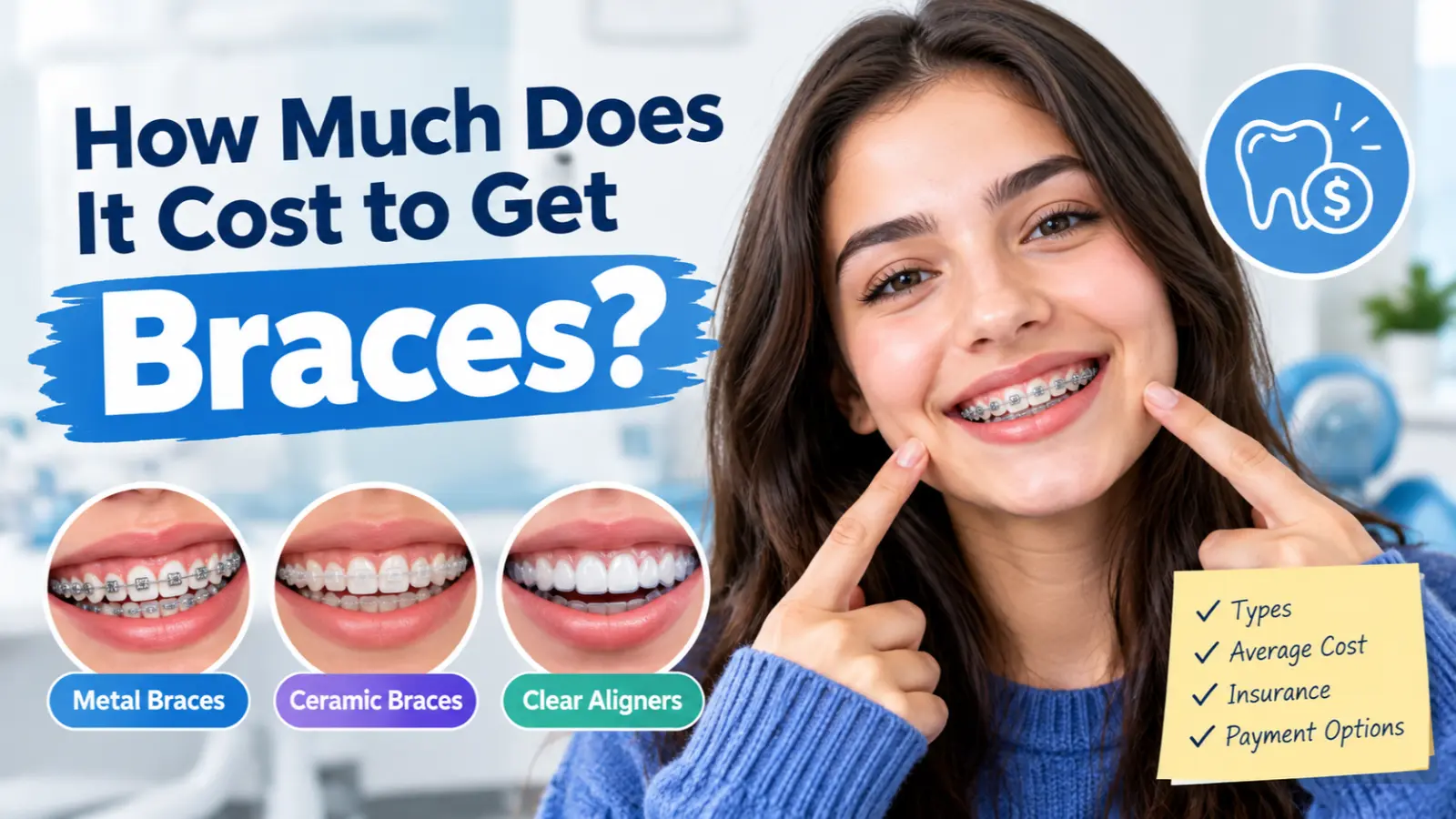
So, how much does it cost to get braces? In the U.S., braces can cost roughly $2,000 to $10,000, depending on the type of treatment, complexity of your case, treatment length, location, and insurance.
Traditional metal braces commonly fall around $3,000 to $7,000, while more discreet options can cost more. Your actual out-of-pocket cost may be much lower with insurance or a payment plan.
Key Takeaways
- Traditional metal braces are generally one of the more affordable orthodontic options.
- U.S. braces costs can vary widely, with treatment often falling within a few thousand dollars.
- Insurance may pay part of orthodontic treatment, but coverage limits and age restrictions vary.
- Your treatment complexity and length can significantly affect the final price.
- Monthly payment plans, HSA/FSA funds, and discounts may make braces easier to afford.
How Much Do Braces Cost in the U.S.?
There is no single price for braces because orthodontic treatment is customized to each patient.
A useful general range is about $2,000 to $10,000 in the U.S. Cleveland Clinic gives this broad range for braces depending on the type of appliance and how much correction is required.
For traditional metal braces specifically, Delta Dental lists a typical range of approximately $3,000 to $7,000.
These figures should be treated as planning ranges rather than guaranteed prices. Your orthodontist may quote more or less depending on your teeth, bite, treatment plan, geographic area, and the services included in the fee.
💡 Key Takeaway: The best way to find out how much braces will cost you is to get a personalized orthodontic evaluation and a written treatment estimate.
Average Cost of Different Types of Braces
The type of orthodontic treatment you choose can have a major effect on the price.
| Treatment Type | Typical U.S. Cost Range |
|---|---|
| Traditional metal braces | $3,000–$7,000 |
| Ceramic braces | $4,000–$8,000 |
| Clear aligners | Often several thousand dollars |
| Lingual braces | $8,000–$10,000 |
These ranges are general estimates, not fixed national prices. Delta Dental reports the ranges above for metal, ceramic, lingual braces, and Invisalign, while the American Association of Orthodontists notes that treatment fees vary based on individual circumstances.
Traditional Metal Braces
Traditional metal braces are often the most budget-friendly fixed-brace option.
They use brackets and wires to gradually move the teeth. They can treat many different orthodontic problems, including crooked teeth, crowding, spacing, and bite problems.
Their main advantage is that they are effective and generally less expensive than some cosmetic alternatives.
Ceramic Braces
Ceramic braces work similarly to traditional braces but use tooth-colored or clear brackets.
They are less noticeable, which makes them popular with teenagers and adults who want a more discreet appearance.
The trade-off is price: ceramic braces generally cost more than traditional metal braces.
Lingual Braces
Lingual braces are attached to the back surfaces of the teeth, making them difficult to see from the front.
Because they require specialized placement and can be more technically demanding, they are usually among the more expensive orthodontic options.
Clear Aligners
Clear aligners use a series of removable, custom-made trays to gradually move teeth.
They can be a convenient and discreet option for appropriate patients, but they are not suitable for every orthodontic problem. An orthodontist should determine whether aligners can effectively treat your particular case.
What Factors Affect the Cost of Braces?
Two people can visit the same orthodontist and receive completely different treatment quotes.
Here are some of the biggest factors.
Type of Treatment
Metal braces, ceramic braces, lingual braces, and clear aligners can have different prices.
Choosing a less visible treatment may increase the cost.
Complexity of Your Case
A person with mild crowding may need less extensive treatment than someone with severe crowding, significant spacing, or a complicated bite problem.
More complicated cases can require additional appliances, longer treatment, or more appointments.
Treatment Length
Orthodontic treatment commonly lasts around 12 to 24 months, although individual treatment times vary.
Longer treatment can mean more appointments and additional orthodontic care.
Location and Orthodontist
Prices can vary between cities, states, and individual practices.
An orthodontist’s experience, office costs, technology, and local market can all influence the fee.
Additional Dental Work
Braces may not be the only dental expense.
If you have cavities, gum disease, or other dental problems, those issues may need to be addressed before or during orthodontic treatment.
You may also need retainers after your braces are removed.
⚠️ Important: Ask whether your quoted price includes examinations, X-rays, adjustments, retainers, and follow-up care. A low initial quote is not necessarily the lowest total treatment cost.
Does Dental Insurance Cover Braces?
Dental insurance may cover part of orthodontic treatment, but you should never assume that your plan will pay for braces.
The American Association of Orthodontists notes that some dental insurance plans include orthodontic benefits, particularly for children, while adult orthodontic coverage is less common.
Your plan may have:
- An age limit
- A deductible
- A percentage that it pays
- A lifetime orthodontic maximum
- Network restrictions
- Waiting periods
- Treatment exclusions
For example, a plan might cover a percentage of orthodontic treatment but stop paying after a specified lifetime maximum.
That means a policy that says it covers orthodontics does not necessarily mean it will pay half of a $6,000 treatment.
The American Dental Association recommends reviewing details such as deductibles, annual or lifetime limits, network requirements, and orthodontic limitations when evaluating dental coverage.
Before starting treatment, contact your insurance company and ask specifically about orthodontic benefits.
How to Make Braces More Affordable
The sticker price can look intimidating, but you may have several ways to reduce or spread out the cost.
Payment Plans
Many orthodontic practices offer monthly payment plans.
Instead of paying the entire treatment fee upfront, you may be able to make an initial payment followed by monthly installments.
Some orthodontists also offer financing arrangements, although terms and interest rates vary.
Ask for the total amount you will pay, not just the monthly payment.
HSA and FSA
If you have an HSA or FSA, orthodontic expenses may qualify depending on the account rules and treatment.
The American Dental Association notes that FSAs can generally be used for eligible dental expenses, including braces needed for dental health reasons.
Check your specific plan before assuming an expense qualifies.
Compare Orthodontic Consultations
Consider getting more than one orthodontic opinion if appropriate.
Ask each office for a written estimate that explains:
- Total treatment cost
- Insurance estimate
- Expected out-of-pocket amount
- Down payment
- Monthly payment
- What is included
- Retainer costs
- Additional possible charges
This makes it much easier to compare offers.
Ask About Discounts
Some orthodontic practices offer discounts for paying in full, multiple family members receiving treatment, or other qualifying arrangements.
Not every practice offers these discounts, so it is worth asking.
💡 Tip: Don’t compare orthodontists based only on the advertised starting price. Compare the complete treatment package and your estimated final out-of-pocket cost.
Braces Cost for Adults vs. Children
Braces can be used successfully for both children and adults.
However, the cost is not automatically higher or lower simply because of age.
Instead, the treatment plan matters more.
Adults may choose ceramic braces or clear aligners because they want a less noticeable option. Those choices can affect the total price.
Insurance can also make a difference. Some dental plans provide orthodontic benefits for children but offer limited or no orthodontic coverage for adults.
The American Association of Orthodontists recommends checking your specific insurance benefits rather than assuming adult or child coverage.
What Should Be Included in a Braces Quote?
Before agreeing to treatment, ask exactly what your quoted price covers.
A comprehensive orthodontic quote may include:
- Initial examination
- Diagnostic records or X-rays
- Braces or orthodontic appliances
- Routine adjustment appointments
- Treatment monitoring
- Braces removal
- Retainers
- Follow-up appointments
However, every practice structures its fees differently.
Ask whether broken brackets, lost aligners, replacement retainers, emergency visits, or additional treatment time create separate charges.
A written treatment agreement can help prevent unexpected costs.
Frequently Asked Questions About Braces Costs
How much are braces without insurance?
Without insurance, braces can cost several thousand dollars. A broad U.S. range is roughly $2,000 to $10,000, while traditional metal braces are commonly cited around $3,000 to $7,000. Your exact price depends on treatment type, complexity, location, and treatment length.
Are braces cheaper than Invisalign?
Not necessarily. Traditional metal braces are often less expensive than clear aligners, but prices vary by patient and orthodontic practice. Clear aligners may be competitively priced for some cases. The treatment that is appropriate for your teeth and bite should be determined by an orthodontic professional.
Does insurance pay for braces?
Some dental insurance plans cover part of orthodontic treatment. Coverage may depend on age, the specific plan, provider network, and lifetime orthodontic maximum. Always verify your benefits directly with your insurer before beginning treatment.
How much do braces cost for adults?
Adult braces can cost roughly $2,000 to $10,000, depending on the type of braces and how much correction is required. Adult insurance coverage is often more limited than coverage for children, so checking your policy is especially important.
What is the cheapest type of braces?
Traditional metal braces are generally among the less expensive orthodontic options. However, the cheapest option is not automatically the best option for every patient. Your orthodontist should recommend treatment based on your dental and bite needs.
Can you pay for braces monthly?
Yes. Many orthodontic offices offer monthly payment plans or financing options. Ask about the down payment, monthly amount, interest, financing fees, and total amount you will pay over the full treatment period.
Final Takeaway
So, how much does it cost to get braces? For many people in the U.S., the total can be several thousand dollars, with commonly cited ranges extending from about $2,000 to $10,000 depending on the treatment.
Traditional metal braces may cost around $3,000 to $7,000, while ceramic and lingual options can cost more.
Your final price depends on your orthodontic needs, treatment type, treatment duration, location, insurance, and payment arrangements.
Before choosing a provider, ask for a detailed written estimate and confirm exactly what your insurance covers. Comparing the total out-of-pocket cost, rather than simply the advertised price, can help you make a smarter decision.

I’m Lydia Laughlin, founder of Punvio, where I craft clever puns, witty wordplay, and humor-filled content to make your day brighter—one laugh at a time.