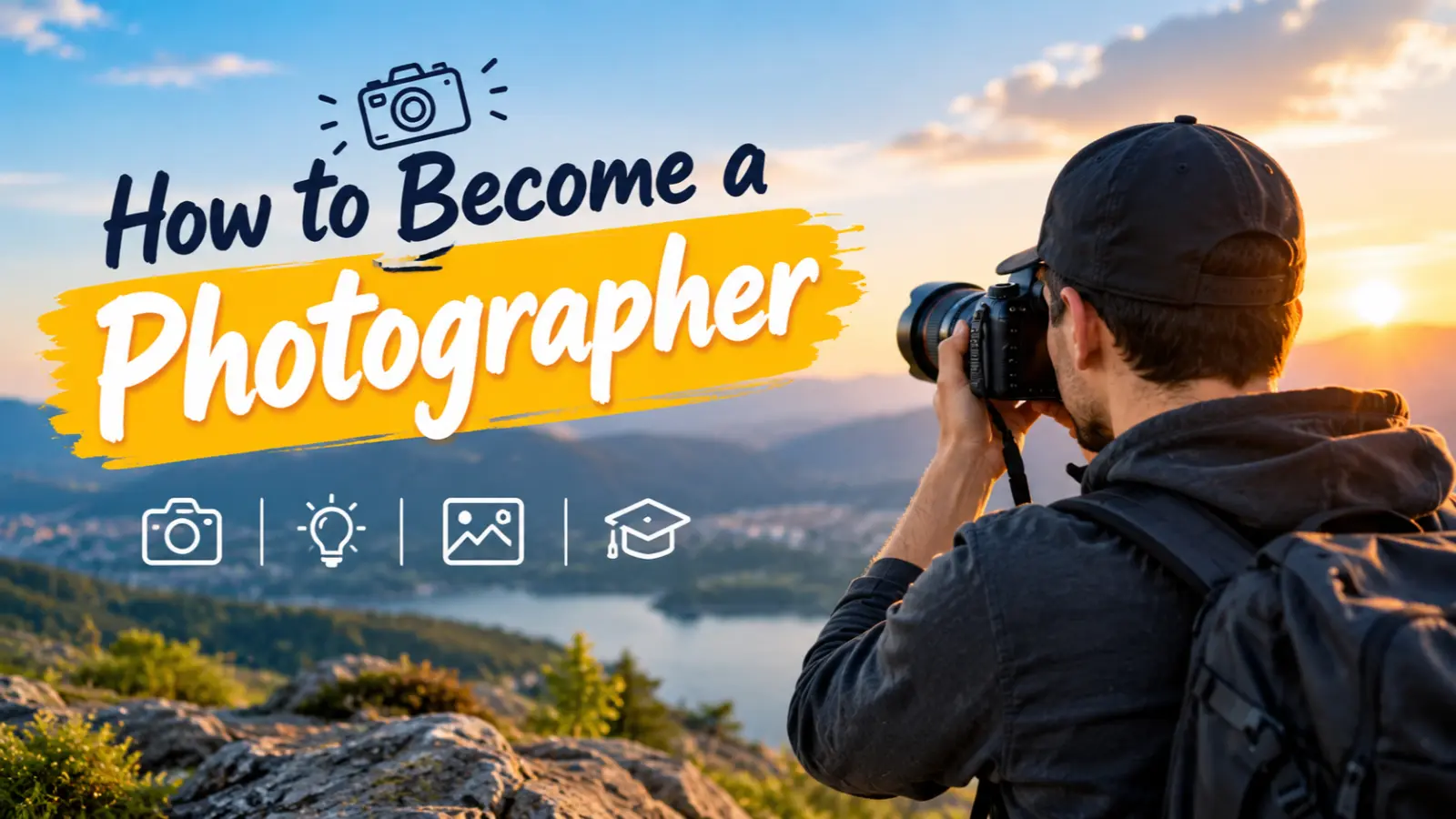
To become a photographer, learn the fundamentals of photography, practice consistently, develop editing and lighting skills, build a strong portfolio, and gain real-world experience.
A photography degree is not always required in the U.S., although classes, certificates, or degrees can help.
You can then choose a specialty, develop business skills, market your services, and begin working with clients.
Key Takeaways
- You do not necessarily need a degree to become a photographer.
- Learn camera settings, composition, lighting, and editing before focusing heavily on expensive equipment.
- Choose a photography niche and build a portfolio specifically for that type of work.
- Gain practical experience by assisting professionals, second shooting, or completing small projects.
- If you work independently, learn pricing, contracts, marketing, client communication, and basic business management.
1. Learn What a Photographer Actually Does
A professional photographer does more than press a camera button. Photographers plan shots, work with lighting, compose images, edit photographs, organize files, communicate with clients, and often market their services.
According to the U.S. Bureau of Labor Statistics (BLS), photographers may photograph people, landscapes, products, buildings, events, and other subjects. Many are self-employed, while others work for organizations or businesses.
Common Photography Specialties
Photography offers many possible career paths, including:
- Portrait photography
- Wedding and event photography
- Commercial photography
- Product photography
- Real estate photography
- Fashion photography
- Sports photography
- Wildlife photography
- Landscape photography
- Photojournalism
- Food photography
- Fine-art photography
You do not have to choose a permanent specialty on your first day. Start by exploring different subjects and notice which type of work you enjoy and perform well.
Skills Photographers Need
Successful photographers generally combine creative and technical abilities.
Important skills include:
- Camera operation
- Composition
- Lighting
- Color and exposure
- Photo editing
- Visual storytelling
- Communication
- Organization
- Time management
- Problem-solving
- Marketing and customer service
💡 Tip: Before spending heavily on equipment, spend time learning how light, composition, and camera settings affect your images.
2. Learn the Fundamentals of Photography
Your first goal should be learning how to control your camera rather than simply relying on automatic settings.
Master Your Camera
Start with the basic exposure controls:
- Aperture controls the lens opening and affects depth of field.
- Shutter speed controls how long the camera captures light and affects motion.
- ISO affects the camera’s sensitivity to light and can also affect image noise.
Then learn focal length, focus modes, white balance, metering, and file formats.
You do not need to master everything immediately. Learn one concept, practice it, review your results, and then move to the next.
Learn Lighting and Composition
Lighting can dramatically change the appearance and mood of an image.
Start with natural light. Practice photographing the same subject at different times of day and from different directions.
Then learn controlled lighting using tools such as flashes, reflectors, or continuous lights.
Composition is equally important. Study concepts such as framing, leading lines, balance, negative space, perspective, and visual hierarchy.
Learn Photo Editing
Professional photography often includes post-production.
Learn how to:
- Organize photographs
- Select your strongest images
- Adjust exposure and color
- Crop and straighten images
- Correct common distractions
- Perform appropriate retouching
- Export files for different uses
Programs such as Lightroom and Photoshop are commonly used in digital photography workflows.
3. Decide Whether You Need Formal Education
One of the biggest questions beginners ask is whether they need a photography degree.
The answer is not necessarily.
The BLS states that photographers typically need a high school diploma or equivalent to enter the occupation, while many photographers take photography classes or earn certificates or degrees to improve their skills.
Becoming a Photographer Without a Degree
You can learn through:
- Online courses
- Local photography classes
- Workshops
- Books and tutorials
- Personal projects
- Assisting professional photographers
- Internships
- Consistent independent practice
This route can be especially useful for people who want to build a freelance photography business.
When a Degree or Certificate Can Help
Formal education can provide structured instruction, feedback, access to equipment, and opportunities to develop a portfolio.
A degree may also be useful for certain employers or photography-related positions that prefer formal education. The BLS notes that some employers may require or prefer a bachelor’s degree in photography, photojournalism, or a related fine-arts field.
The important point is that education is one possible path not the only path.
Key Takeaway: A degree can provide structure and training, but becoming a photographer also depends heavily on practical skills, experience, and the quality of your portfolio.
4. Get the Right Photography Equipment
You do not need the most expensive camera to begin learning photography.
A practical starter setup may include:
| Equipment | Main purpose |
| Camera | Capturing photographs |
| Versatile lens | General-purpose shooting |
| Memory cards | Storing images |
| Extra battery | Longer shooting sessions |
| Tripod | Stability and slower shutter speeds |
| Computer | Editing and file management |
| Editing software | Processing and organizing images |
| Camera bag | Protecting equipment |
The equipment you eventually need depends heavily on your specialty.
For example, a wildlife photographer may need long telephoto lenses, while a studio portrait photographer may prioritize lighting equipment.
Don’t Buy Everything at Once
Start with equipment that solves an actual problem.
As your skills develop, you will understand what your photography requires. Renting or borrowing specialized equipment can also help you test it before making a major purchase.
5. Choose a Photography Niche
A niche gives your photography a clear direction.
Instead of trying to create a portfolio containing everything from landscapes to weddings to food photography, consider building a focused body of work.
For example:
Wedding photographer → wedding ceremonies, receptions, couples, details, and candid moments.
Product photographer → clean product images, lifestyle photographs, details, and commercial compositions.
Real estate photographer → interiors, exteriors, rooms, architectural details, and property features.
Choosing a niche can make it easier to understand your ideal client and create relevant marketing.
You can always change or expand your specialty later.
6. Build a Strong Photography Portfolio

Your portfolio is one of the most important tools in a photography career.
It allows potential clients or employers to see what you can actually produce.
What to Put in Your Portfolio
Choose photographs that demonstrate:
- Technical quality
- Consistent editing
- Strong composition
- Good lighting
- Creativity
- Your chosen specialty
- Your personal style
Quality matters more than quantity.
If you have 100 photographs but only 15 are excellent, showcase the strongest 15.
Create Practice Projects
You do not need paid clients to start building a portfolio.
Create your own projects.
For example:
- Photograph local architecture.
- Create a portrait session with friends.
- Photograph products around your home.
- Practice food photography.
- Create a mock real estate shoot.
- Photograph a local sporting event.
- Collaborate with models, designers, or small businesses.
These projects give you material to evaluate and improve.
💡 Tip: Build your portfolio around the type of photography you want to get hired for not simply the photographs you happen to have.
7. Gain Real-World Experience
Practice teaches you photography, but real assignments teach you how photography works as a profession.
One practical way to gain experience is to assist an established photographer. The BLS specifically notes that photographers may start as assistants, where they can learn on the job, gain experience, build portfolios, and develop professional connections.
You can also look for:
- Photography internships
- Second-shooter opportunities
- Community projects
- Small business collaborations
- Volunteer photography assignments
- Entry-level creative roles
Pay attention to everything, not just the camera work.
Watch how professionals communicate with clients, organize equipment, manage schedules, solve problems, deliver images, and handle unexpected situations.
8. Learn the Business Side of Photography
If you plan to freelance, photography is also a business.
You may need to understand:
- Pricing
- Estimates
- Contracts
- Invoices
- Client communication
- Usage rights
- Marketing
- Scheduling
- File delivery
- Record keeping
- Business expenses
Professional photographers may also need to market their services, schedule appointments, maintain equipment, manage finances, and maintain a digital portfolio.
Do not wait until you have dozens of clients before learning these basics.
Pricing, Contracts, and Client Communication
Before accepting paid work, know exactly what you are offering.
A clear agreement should explain important details such as the services provided, deliverables, timing, payment terms, and other relevant expectations.
Good communication can prevent many problems before a photo shoot begins.
Marketing and Networking
You can promote your photography through:
- A professional website
- Social media
- Local networking
- Referrals
- Business partnerships
- Photography communities
- Search engine optimization
- Client reviews
Your marketing should clearly communicate what you photograph and who you serve.
9. Find Your First Photography Clients
Your first clients may come from people you already know, local businesses, community organizations, referrals, or professional connections.
Start small.
For example, if you want to become a portrait photographer, you could create several strong portrait sessions and use them to build a focused portfolio.
Then contact potential clients who genuinely need that service.
Another effective approach is collaboration. Work with a local makeup artist, clothing brand, realtor, restaurant, model, or small business where both sides can benefit from professional imagery.
As you complete projects, ask satisfied clients whether they are comfortable providing a testimonial or referral.
10. Photographer Salary and Career Outlook in the U.S.
Photography income varies significantly because photographers work in different specialties and employment arrangements.
The U.S. Bureau of Labor Statistics reports a median annual wage of $44,660 for photographers in May 2025, or $21.47 per hour. The BLS also projects photographer employment to decline 1% from 2025 to 2035, while estimating about 10,700 openings per year on average during that period, primarily because workers leave or transfer from the occupation.
These figures describe the occupation nationally and should not be treated as a guaranteed income for an individual photographer.
Freelancers and business owners can have very different revenue, expenses, schedules, and workloads depending on their specialty, location, pricing, and client base.
11. Frequently Asked Questions
Do you need a degree to become a photographer?
No. A photography degree is not generally required to enter the occupation. Many photographers learn through classes, certificates, independent practice, assisting, or hands-on experience. However, formal education can provide structured training and may be preferred for some positions.
How long does it take to become a photographer?
There is no fixed timeline. You can begin learning photography immediately, but developing professional-level skills takes consistent practice. Your timeline will depend on how often you shoot, how quickly you learn, your specialty, and whether you pursue formal education or mentorship.
What equipment do you need to start photography?
A basic setup can include a capable camera, a versatile lens, memory cards, spare batteries, a computer, and editing software. Additional lenses, tripods, flashes, and lighting equipment can be added as your specialty and assignments require them.
How do photographers get their first clients?
Beginners often start through personal networks, referrals, collaborations, local businesses, internships, assisting opportunities, social media, and portfolio websites. The strongest approach is to show relevant work and clearly explain the service you offer.
How much do photographers make?
The BLS reports a U.S. median annual wage of $44,660 for photographers in May 2025. Actual income varies based on specialty, experience, employment type, location, workload, and business expenses.
Conclusion
Learning how to become a photographer is a process rather than a single qualification. Start by mastering camera fundamentals, composition, lighting, and editing.
Then choose a specialty, build a focused portfolio, gain practical experience, and learn how to work with clients.
You do not necessarily need a photography degree to begin. What matters is developing skills and producing work that demonstrates what you can do.
If you plan to work independently, treat photography as both a creative craft and a business.
Start with the equipment you have, practice consistently, study the work of photographers you admire, and gradually take on real projects.
With time, your portfolio, experience, professional network, and confidence can develop alongside your photography career

I’m Daniel Moja, the expert behind Punvio.com, where I share the funniest, wittiest, and most creative puns to make your day brighter.
Explore my handpicked wordplay and laugh along with me!