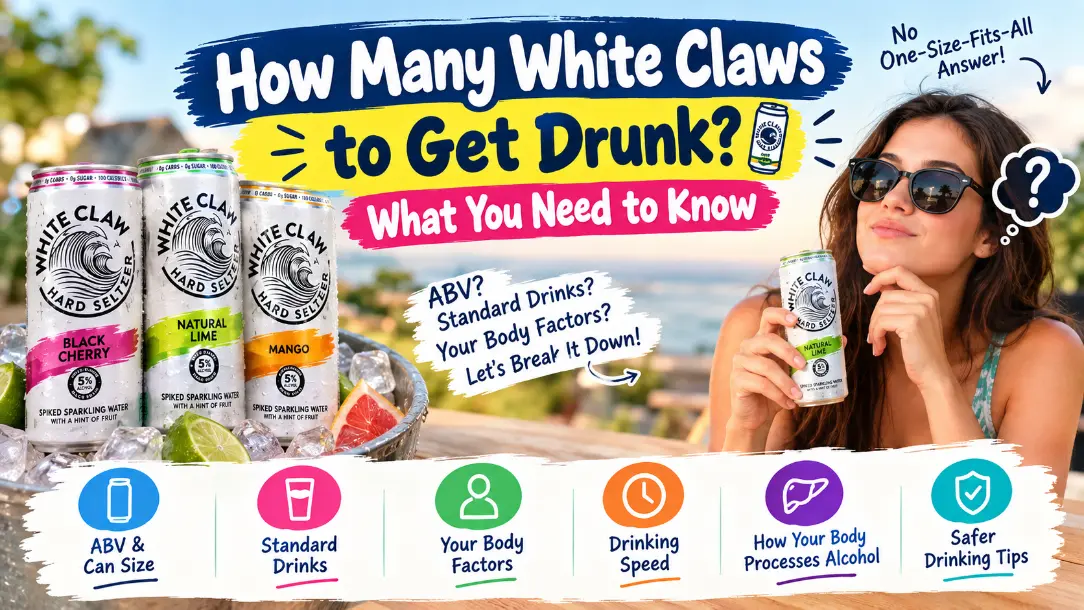
Scroll through TikTok or Reddit long enough and you’ll spot the same question in every comment section: how many White Claws does it actually take to get drunk?
It’s a fair thing to wonder if hard seltzers taste more like sparkling water than alcohol, which makes it easy to lose count of how many you’ve had.
But there’s no single number that applies to everyone, and honestly, anyone promising you an exact count is oversimplifying how alcohol actually works.
What does determine your buzz is a mix of factors: White Claw’s alcohol by volume (ABV), how that compares to a “standard drink,” and personal variables like body weight, food intake, and tolerance.
In this guide, we’ll break down exactly what’s in a can, how your body processes it, and how to enjoy a hard seltzer season without overdoing it — because knowing your limits matters more than knowing a magic number.
⚡ Quick Answer: How Many White Claws Does It Take to Get Drunk?
There is no universal number of White Claws that will make everyone drunk.
The effects depend on factors such as:
- 🍹 ABV and can size
- ⚖️ Body weight and composition
- 🍽️ Food intake
- ⏱️ Drinking speed
- 🧬 Metabolism and genetics
- 💊 Medications and health conditions
- 🥂 Alcohol tolerance
A better way to understand alcohol intake is to look at standard drinks, alcohol content, serving size, and your body’s response rather than simply counting cans.
─────────────────────────
💡 KEY TAKEAWAY: The same number of cans can affect two people very differently.
─────────────────────────
🥤 What’s Actually in a White Claw?
Before you can figure out how alcohol affects you, it helps to know exactly what you’re drinking.
White Claw isn’t beer, wine, or liquor; it’s a malt-based hard seltzer, fermented from a gluten-free base and mixed with carbonated water and natural fruit flavoring.
That clean, light taste is part of why it’s easy to underestimate.
📊 Alcohol by Volume (ABV) by Product Line
| White Claw Product | Typical ABV |
|---|---|
| Original flavors | 5% |
| White Claw Surge | 8% |
| White Claw Vodka line | Varies by product |
| White Claw 0% Alcohol | 0% |
Important: ABV percentages can shift as the brand updates its lineup, so it’s always worth checking the label on the can you’re actually holding rather than assuming.
📏 Can Size Matters More Than People Think
A standard White Claw can is 12 ounces, but tallboys and variety packs with larger cans are common.
A 16 oz can at 8% ABV contains significantly more total alcohol than a 12 oz can at 5% ABV — even though it “feels” like just one can either way.
🍺 How White Claw Compares With Other Drinks
A 12 oz White Claw at 5% ABV is roughly in line with a light beer and well below the ABV of wine or hard liquor.
| Beverage | Typical Serving | Typical ABV |
|---|---|---|
| White Claw Original | 12 oz | 5% |
| Light beer | 12 oz | Around 5% |
| Wine | 5 oz | Around 9–14% |
| Hard liquor | 1.5 oz | Around 40% |
But because hard seltzer can be easier to drink quickly, the comparison isn’t just about ABV — it’s about how much and how fast you actually consume.
─────────────────────────
📌 IMPORTANT: Always check the actual can size and ABV instead of assuming every White Claw contains the same amount of alcohol.
─────────────────────────
🍸 The “Standard Drink” Concept
Knowing a can’s ABV only tells half the story.
What actually matters for tracking your alcohol intake is the concept of a standard drink.
🧮 What Counts as a Standard Drink?
In the U.S., a standard drink contains roughly 14 grams (about 0.6 fluid ounces) of pure alcohol.
That’s the amount typically found in:
- 🍺 A 12 oz beer at 5% ABV
- 🍷 A 5 oz glass of wine at 12% ABV
- 🥃 A 1.5 oz shot of liquor at 40% ABV
📊 Where White Claw Fits In
A standard 12 oz can of White Claw Original at 5% ABV works out to almost exactly one standard drink — about 0.6 oz of pure alcohol.
Where it gets less intuitive:
| Drink | Size | ABV | Approx. Standard Drinks |
|---|---|---|---|
| White Claw Original | 12 oz | 5% | ~1 |
| White Claw Original | 16 oz | 5% | ~1.3 |
| White Claw Surge | 12 oz | 8% | ~1.6 |
| White Claw Surge | 16 oz | 8% | ~2 |
Three 12 oz Originals represent roughly three standard drinks.
Three 16 oz Surge cans can represent closer to six standard drinks — double the alcohol, in a format that still looks and drinks like “just one seltzer.”
🎯 Why Standard Drinks Matter
This is really the core of why there’s no universal “X cans and you’re drunk” answer.
The same number of cans can represent very different total alcohol amounts depending on ABV and size.
Standard drinks, not can count, are the more accurate way to track what you’ve actually consumed.
─────────────────────────
💡 KEY TAKEAWAY: One can does not always equal one standard drink. Check both the serving size and ABV.
─────────────────────────
👤 Why There’s No Universal Number
Even if two people drink the exact same number of standard drinks, they won’t necessarily feel the same effects.
That’s because alcohol’s impact depends heavily on individual biology and circumstances, not just volume consumed.
⚖️ Body Weight and Composition
Alcohol distributes through body water, so someone with more total body mass typically has more volume for the alcohol to dilute into.
Muscle and fat also hold water differently, which adds another layer of variation between individuals.
🧬 Biological Sex
On average, differences in body water percentage and how the body metabolizes alcohol mean the same amount of alcohol tends to produce a higher blood alcohol concentration in women than in men of similar weight.
🍽️ Food in Your Stomach
Drinking on an empty stomach allows alcohol to pass into the bloodstream much faster.
Eating beforehand — especially protein, fat, and fiber — slows absorption and blunts how quickly you feel effects.
⏱️ Drinking Pace
Your liver metabolizes alcohol at a relatively fixed rate.
Drinking multiple cans quickly means alcohol builds up in your bloodstream faster than your body can process it, leading to a stronger and faster effect than sipping the same amount over several hours.
🥂 Tolerance
Regular drinkers often develop tolerance, needing more alcohol to feel the same effects.
But this doesn’t mean their body is being harmed any less — just that the subjective feeling of drunkenness comes later.
💊 Medications and Health Conditions
Certain medications, liver conditions, or even lack of sleep can significantly amplify alcohol’s effects, sometimes unpredictably.
🧬 Genetics
Some people have genetic variations affecting the enzymes that break down alcohol, causing them to feel effects — or side effects like flushing — much more intensely than others.
Put together, these factors explain why a number that gets one person mildly buzzed could leave another person significantly impaired.
It’s genuinely not possible to give a one-size-fits-all can count.
─────────────────────────
💡 IMPORTANT: Alcohol affects people differently. A drink count that produces mild effects in one person may cause significant impairment in another.
─────────────────────────
🧠 How Your Body Processes Alcohol
Once alcohol enters your system, your body starts working to break it down almost immediately — but there’s a hard limit to how fast that process can go, no matter how much you drink.
⚡ Absorption Starts Fast
Alcohol begins entering the bloodstream through the stomach and small intestine within minutes of your first sip.
Carbonation — like the bubbles in White Claw — can actually speed up absorption slightly compared to still drinks, which is part of why seltzers can hit a little faster than people expect.
🫀 The Liver Sets the Pace
Your liver metabolizes alcohol at a roughly steady rate, often cited as somewhere around one standard drink per hour for an average adult — though this varies significantly by individual.
Critically, this rate doesn’t speed up no matter how much you drink.
If you’re consuming faster than your liver can process, alcohol simply accumulates in your bloodstream.
📈 Blood Alcohol Concentration (BAC) Is the Real Metric
BAC measures the percentage of alcohol in your bloodstream and is what legal and medical guidelines actually use to define impairment levels.
BAC cannot be accurately determined simply by counting cans.
⚠️ Why “I Feel Fine” Is Unreliable
Impairment often outpaces perception.
Judgment, reaction time, and coordination can be affected before someone subjectively feels “drunk.”
This is part of why people frequently misjudge whether they’re okay to drive or make decisions after drinking.
─────────────────────────
📌 KEY TAKEAWAY: Feeling fine isn’t a reliable way to determine whether you’re unimpaired.
─────────────────────────
🚨 Signs of Different Intoxication Levels
Rather than tying effects to a specific number of cans, it’s more useful — and more accurate — to recognize the general signs your body gives you at different stages.
These are broad patterns, not precise thresholds. Everyone’s experience will vary.
🟢 Mild Effects
- Slight relaxation or lowered inhibitions
- Mild warmth or flushing
- Small increases in talkativeness or sociability
- Subtle changes in mood
🟠 Moderate Impairment
- Noticeably slower reaction time
- Impaired judgment and decision-making
- Difficulty with coordination or fine motor tasks
- Slurred speech beginning to appear
- Reduced short-term memory formation
🔴 Significant Impairment
- Clearly slurred speech
- Loss of balance or difficulty walking normally
- Poor judgment
- Blurred or impaired vision
- Nausea
🆘 Danger Signs: When to Seek Help
- Confusion or inability to stay conscious
- Vomiting, especially while lying down
- Slow or irregular breathing
- Cold, clammy, or bluish-tinged skin
- Seizures
- Inability to be woken up
That last category describes potential alcohol poisoning, which is a medical emergency.
If someone shows these signs, call emergency services right away. Don’t wait to see if they “sleep it off,” and don’t leave them alone.
Alcohol poisoning can be fatal, and it’s better to overreact than underreact.
─────────────────────────
🚨 IMPORTANT: If someone is difficult to wake, unconscious, having seizures, or breathing slowly or irregularly, seek emergency medical help immediately.
─────────────────────────
🛡️ Safer Drinking Practices
Understanding what’s in your can and how your body processes it is only useful if you put it into practice.
Here’s how to actually apply it.
⏱️ Pace Yourself
Since your liver processes alcohol at a relatively fixed rate, spacing drinks out rather than drinking them back-to-back gives your body more time to keep up.
💧 Alternate With Water
Having a glass of water between cans can slow your overall drinking pace and helps offset the mild dehydrating effect of alcohol.
🍽️ Eat Beforehand and During
Food slows alcohol absorption significantly.
A meal with protein and fat before you start drinking — and snacking throughout — can meaningfully change how quickly effects hit you.
🥤 Know Your Can, Not Just Your Count
A 16 oz Surge can isn’t the same as a 12 oz Original.
Checking the ABV and size on what you’re actually drinking gives you a much clearer picture than simply counting cans.
🚗 Never Drink and Drive
Even if you feel “fine,” impairment can affect reaction time and judgment before you notice it subjectively.
If you’ve been drinking, plan a ride home in advance:
- Designated driver
- Rideshare
- Public transportation
📱 Use Tools Instead of Guessing
BAC calculator apps and personal breathalyzers exist because self-assessment is unreliable.
If precision actually matters for a decision you’re making, use one rather than trusting how you feel.
🛑 Recognize When to Stop
Revisit the intoxication signs from the last section.
If you’re noticing moderate impairment symptoms, that’s a natural point to slow down or switch to water and food for the rest of the night.
👀 Watch Out for Friends, Too
Knowing the signs of alcohol poisoning isn’t just about yourself.
Being able to recognize it in someone else — and knowing to call for help rather than wait it out — can genuinely save a life.
─────────────────────────
💡 KEY TAKEAWAY: Focus on pacing, food, hydration, alcohol content, and safety rather than trying to reach a specific level of intoxication.
─────────────────────────
🍹 Common Myths About White Claw and Getting Drunk
There are several misconceptions about hard seltzer and alcohol that can make it difficult to judge how strongly a drink may affect you.
Here are some of the most common myths.
💧 Myth: “Hard Seltzer Is Basically Water”
White Claw may be light, carbonated, and refreshing, but it is still an alcoholic beverage.
Its appearance and taste don’t mean it affects your body like water.
The alcohol content depends on the specific product and its ABV (alcohol by volume).
🍓 Myth: “Flavored Means Weaker”
A fruity or flavored White Claw isn’t necessarily weaker than another alcoholic drink.
Flavor mainly affects taste.
To understand the strength of a drink, check its ABV and serving size rather than judging it by how sweet or light it tastes.
🥃 Myth: “Mixing Liquors Makes You Drunker”
Mixing different types of alcohol doesn’t automatically make you more intoxicated than consuming the same total amount of alcohol from one type.
Factors such as:
- Total alcohol consumed
- Drinking speed
- Food intake
- Body size
- Metabolism
- Individual response
can influence intoxication.
─────────────────────────
💡 KEY TAKEAWAY: There is no reliable universal number of White Claws that will make everyone drunk. Alcohol affects people differently, and the amount and speed of consumption matter.
─────────────────────────
❓ FAQs About How Many White Claws to Get Drunk
How many White Claws does it take to get drunk?
There is no universal number of White Claws that will make everyone drunk.
The effects of alcohol vary based on factors such as body size, metabolism, food intake, drinking speed, tolerance, medications, and the drink’s alcohol content.
How strong is White Claw?
White Claw products can have different alcohol contents depending on the specific product and variety.
Check the ABV (alcohol by volume) and serving size on the can to know exactly what you’re drinking.
Can one White Claw make you drunk?
It can affect different people differently.
Someone with lower alcohol tolerance may notice effects from a smaller amount, while another person may experience fewer noticeable effects.
Feeling fine also doesn’t necessarily mean you’re unimpaired.
Does drinking White Claw quickly make you drunk faster?
Drinking alcohol quickly can cause your blood alcohol concentration to rise more rapidly.
Drinking more slowly gives your body more time to process the alcohol.
Does eating before drinking affect how alcohol feels?
Food can affect how quickly alcohol is absorbed and may slow the rise in blood alcohol concentration.
However, eating does not prevent intoxication or make drinking and driving safe.
Does mixing White Claw with other alcohol make you drunker?
Mixing different alcoholic beverages doesn’t inherently create a special type of intoxication.
The total amount of alcohol consumed, along with drinking speed and individual factors, is more relevant.
Can a BAC calculator tell me if I’m safe to drive?
BAC calculators can provide estimates, but they cannot guarantee that you are safe or legally able to drive.
If you’ve been drinking, the safest option is to avoid driving.
How long does alcohol stay in your system?
The amount of time alcohol remains in the body varies from person to person and depends on factors including how much alcohol was consumed and individual metabolism.
You cannot reliably speed up alcohol elimination with coffee, cold showers, or other quick fixes.
What should I do if someone has had too much alcohol?
If someone is difficult to wake, unconscious, having seizures, vomiting repeatedly, breathing slowly or irregularly, or showing signs of severe alcohol poisoning, seek emergency medical help immediately.
Don’t leave the person alone or assume they can simply sleep it off.
─────────────────────────
💡 QUICK ANSWER: There is no fixed number of White Claws that guarantees intoxication. Alcohol affects people differently, so focus on alcohol content, serving size, pace of drinking, and safety rather than a specific can count.
─────────────────────────
📝 Conclusion
So, how many White Claws does it take to get drunk?
There isn’t one number that applies to everyone.
Your response to alcohol can vary based on the drink’s ABV, serving size, how quickly you drink, whether you’ve eaten, body size, metabolism, medications, and other individual factors.
Instead of relying on a specific can count, pay attention to serving sizes, alcohol content, and how your body is responding.
If you’ve been drinking, don’t drive or operate machinery.
BAC calculators can provide an estimate based on available information, but they cannot guarantee that you’re safe or legally able to drive.
─────────────────────────
⚠️ IMPORTANT: Don’t use a specific drink count or BAC estimate as a guarantee of safety. If you’ve been drinking, the safest choice is to avoid driving.
─────────────────────────

I’m Ella Punster, a pun expert, and I create witty, fun, and clever puns ono Punvio to make your day brighter. Explore my unique wordplay and join me in celebrating the joy of humor