If you’ve just planted grass seed, you’re probably wondering when you’ll finally see those first green blades.
So, how long does it take grass seed to grow?
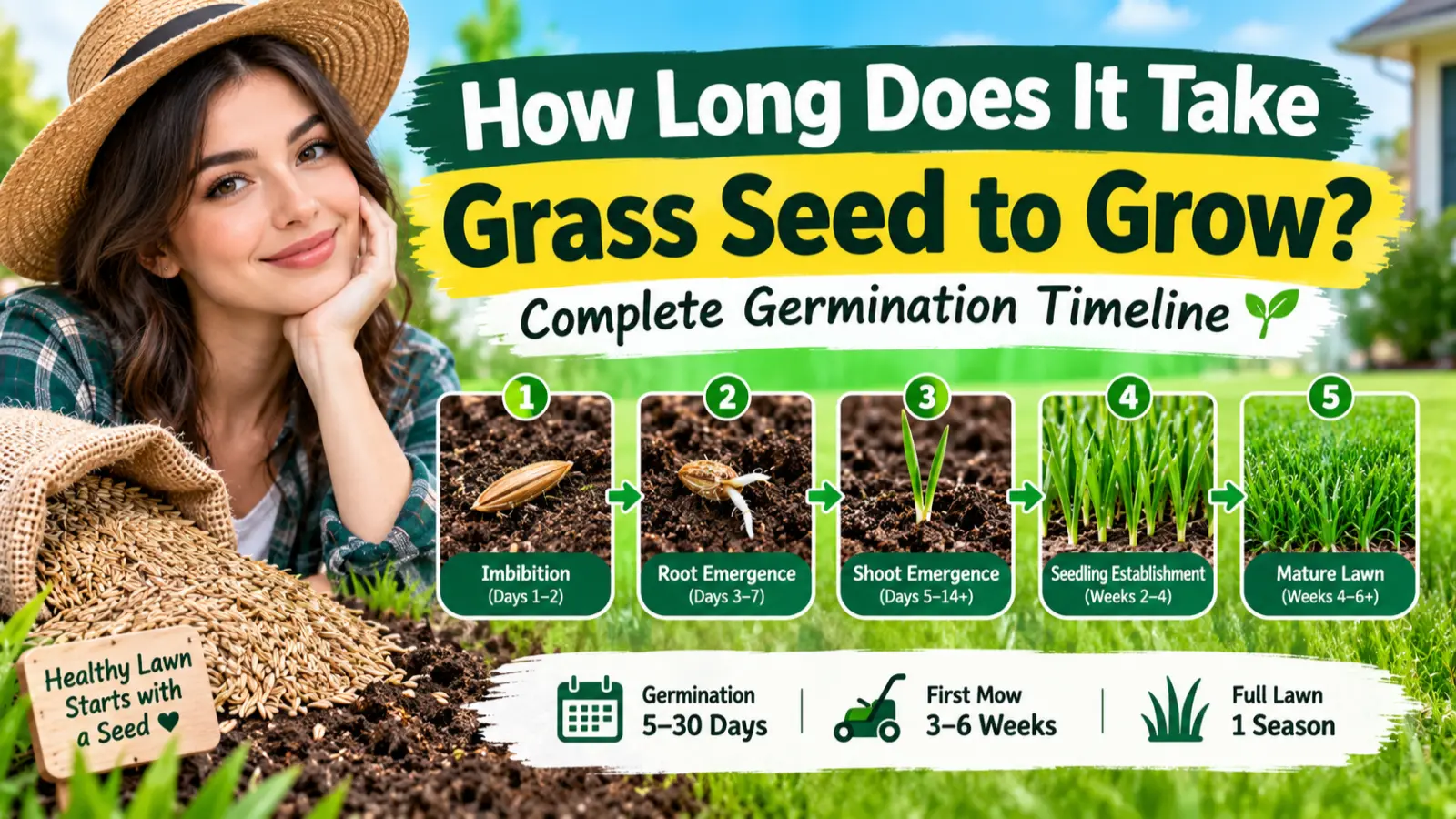
Most grass seed begins to germinate within 5 to 30 days, depending on the grass type, soil temperature, moisture, seed quality, and growing conditions. Some varieties can sprout within a week, while others may take several weeks.
A newly seeded lawn may be ready for its first mowing in around 3 to 6 weeks, but establishing a thick, healthy lawn can take considerably longer.
In this guide, you’ll learn how long grass seed takes to germinate, the growth stages, germination times for different grass types, the best planting season, watering requirements, mowing timing, common mistakes, and practical tips for faster establishment.
How Long Does Grass Seed Take to Germinate? 🌱
Most grass seed starts germinating within 5–30 days.
The exact timing depends on the grass variety and environmental conditions.
A simple general timeline looks like this:
- Fast-germinating grass: 5–10 days
- Moderate-germinating grass: 10–21 days
- Slow-germinating grass: 21–30+ days
- First mowing: Around 3–6 weeks
- Full establishment: Several weeks to a full growing season
The first green blades are only one part of the process. Before you see growth above the soil, the seed is absorbing water, developing roots, and preparing its first shoot.
Key Takeaway: 🌱 Don’t assume your grass seed has failed after only a few days. Always compare the progress with the normal germination period for your specific grass variety.
The Grass Seed Germination Timeline, Stage by Stage 🌿
Grass seed goes through several stages before it becomes a mowable lawn.
Stage 1: Imbibition — Days 1–2
The seed absorbs water and begins to swell.
This activates the internal processes that allow the seed to use its stored energy for growth.
You normally won’t see anything above the soil at this stage.
Stage 2: Root Emergence — Days 3–7
A tiny root called the radicle begins growing downward into the soil.
This root anchors the seed and starts absorbing water and nutrients.
Stage 3: Shoot Emergence — Days 5–14+
The first shoot begins moving toward the soil surface.
This is when you may finally notice tiny green blades appearing.
Stage 4: Seedling Establishment — Weeks 2–4
The seedlings begin developing stronger roots and additional leaves.
The lawn may still look thin or patchy, which is normal during early establishment.
Stage 5: Early Lawn Development — Weeks 4–6+
Depending on the grass variety and growing conditions, the grass may reach a suitable height for its first mowing.
However, the lawn is still developing its root system and density.
Tip: 🌱 The first mowing is a milestone, not the end of establishment. Continue providing proper water and protection after the first cut.
Grass Seed Germination Time by Type 🌾
Different grass varieties germinate at different speeds.
Cool-season grasses generally prefer cooler growing conditions, while warm-season grasses perform better in warmer soil.
Cool-Season Grasses
Common cool-season grasses include:
- Perennial ryegrass
- Tall fescue
- Fine fescue
- Kentucky bluegrass
Perennial ryegrass is generally one of the faster germinating lawn grasses, while Kentucky bluegrass typically takes longer.
Warm-Season Grasses
Common warm-season grasses include:
- Bermuda grass
- Zoysia grass
- Centipede grass
- Bahia grass
These varieties generally need warmer soil before they germinate reliably.
Grass Seed Germination Chart
| Grass Type | Category | Typical Germination | Approx. First Mow |
|---|---|---|---|
| Perennial Ryegrass | Cool-season | 5–10 days | ~3 weeks |
| Tall Fescue | Cool-season | 7–14 days | ~3–4 weeks |
| Fine Fescue | Cool-season | 7–21 days | ~4 weeks |
| Kentucky Bluegrass | Cool-season | 14–30 days | ~5–6 weeks |
| Creeping Bentgrass | Cool-season | 10–21 days | ~4 weeks |
| Bermuda Grass | Warm-season | 10–30 days | ~4–5 weeks |
| Zoysia Grass | Warm-season | 14–30+ days | ~5–6 weeks |
| Centipede Grass | Warm-season | 14–28 days | ~5 weeks |
| Bahia Grass | Warm-season | 14–30 days | ~5–6 weeks |
These are general estimates. Actual germination can vary depending on soil temperature, moisture, seed quality, planting depth, and weather.
Important: 🌱 Grass variety matters. Before worrying about slow growth, check the normal germination period for the exact seed you planted.
What Temperature Does Grass Seed Need to Germinate? 🌡️
Soil temperature is one of the most important factors affecting grass seed germination.
Cool-season grasses generally prefer cooler soil conditions, while warm-season grasses require warmer soil.
If the soil is outside the preferred temperature range for your grass variety, germination can slow down considerably.
For this reason, checking soil temperature can be more useful than looking only at the day’s air temperature.
Key Takeaway: 🌡️ The right temperature can make a major difference in germination speed. Always consider the temperature requirements of your specific grass variety.
Best Time of Year to Plant Grass Seed 🍃
Planting at the right time gives grass seed a better chance of germinating quickly and establishing strong roots.
Cool-Season Grass
For many cool-season grasses, early fall is an excellent planting period because soil can remain warm while air temperatures become more moderate.
Early spring can also work, although young grass may face increasing heat and drought stress as summer approaches.
Warm-Season Grass
Warm-season grasses generally perform best when planted in late spring or early summer, once soil temperatures are sufficiently warm.
Regional Considerations
Your local climate should always be considered.
- Northern regions: Cool-season grasses are commonly preferred.
- Southern regions: Warm-season grasses are often more suitable.
- Transition zones: Both types may work depending on local conditions.
Tip: 🍃 Choosing the right grass for your climate and planting it during the appropriate season can be more important than trying to speed up germination afterward.
How to Make Grass Seed Grow Faster 🌱
You cannot force grass to grow outside its natural biological timeline, but you can create conditions that encourage healthy and uniform growth.
1. Prepare the Soil
Remove rocks, debris, weeds, and dead vegetation.
Loosen compacted soil and create a smooth seedbed.
2. Test Your Soil
A soil test can identify pH and nutrient issues.
Use the results to determine whether amendments or fertilizer are actually needed.
3. Choose Quality Seed
Use fresh, high-quality seed with a good germination rate.
Check the seed label for germination information and storage conditions.
4. Keep the Seedbed Moist
Newly planted seed needs consistent moisture during germination.
Avoid allowing the surface to repeatedly dry out.
5. Improve Seed-to-Soil Contact
Lightly rake the area after spreading seed so the seeds make good contact with the soil.
6. Use a Thin Protective Cover
A thin layer of appropriate mulch can help protect seed and retain moisture.
Avoid applying a thick layer that blocks sunlight or prevents seedlings from emerging.
7. Limit Foot Traffic
Keep pets, children, and unnecessary traffic away from newly seeded areas.
Tip: 🚀 The safest way to encourage faster grass growth is to provide ideal conditions—not excessive fertilizer or water.
Watering Guide for New Grass Seed 💧
Proper watering is essential during grass seed germination.
The watering routine should gradually change as the grass becomes established.
Days 1–14
Keep the upper soil surface consistently moist.
Water gently to avoid washing seeds away or creating puddles.
Weeks 2–4
As seedlings develop roots, gradually move toward deeper and less frequent watering.
Make this transition slowly because young seedlings still need consistent moisture.
Week 4 and Beyond
Once the lawn is established, gradually transition toward a normal watering schedule based on your grass type, soil, rainfall, and climate.
Important: 💧 More water does not automatically mean faster growth. Overwatering can cause serious problems, including poor root development and disease.
Signs of Healthy vs. Delayed Grass Growth 🌿
It’s normal to worry when your new lawn looks patchy during the early stages.
Signs of Healthy Growth
Look for:
- Tiny green shoots appearing within the expected period
- Gradually increasing grass height
- Stronger and thicker seedlings
- More uniform growth
- Better root development
Signs Growth May Be Delayed
Possible warning signs include:
- Large areas with no germination
- Persistent yellowing
- Excessively wet soil
- Mold or fungal growth
- Seed washing away
- Growth stopping after initial sprouting
If germination is significantly delayed, check:
- Soil temperature
- Moisture levels
- Seed quality
- Seed-to-soil contact
- Planting depth
- Recent weather
- Grass variety
Key Takeaway: 🔍 Patchy growth during the first few weeks does not always mean failure. Give the seed enough time before reseeding or making major changes.
Common Mistakes That Slow Grass Seed Growth 🚫
Several common mistakes can delay germination and weaken young grass.
Overwatering
Excessive water can saturate the soil, encourage disease, and wash seeds away.
Underwatering
Allowing newly planted seed to dry out repeatedly can interrupt germination.
Choosing the Wrong Grass
A grass variety that does not match your local climate may struggle even with good care.
Poor Seed-to-Soil Contact
Seeds sitting loosely on hard soil may have difficulty establishing.
Planting at the Wrong Time
Unfavorable soil temperatures can slow germination.
Skipping Soil Preparation
Compacted or poorly prepared soil can make establishment more difficult.
Using Old Seed
Poorly stored or old seed may have reduced viability.
Heavy Foot Traffic
Walking or playing on newly seeded areas can disturb young seedlings.
Important: 🚫 Before trying complicated lawn treatments, check the basics: grass type, planting season, soil preparation, moisture, and seed quality.
When Can You Mow New Grass? ✂️
Avoid mowing newly germinated grass too early.
Instead, wait until the grass has reached an appropriate height and is established enough to tolerate mowing.
A useful general rule is the one-third rule: avoid removing more than one-third of the grass blade height in a single mowing.
For many lawns, the first mowing may happen around 3–6 weeks after planting, but the exact timing depends on the grass type and growing conditions.
Use a sharp mower blade to make a clean cut.
Tip: ✂️ Don’t mow simply because a certain number of days has passed. Check the actual grass height and make sure the seedlings are firmly established first.
When Is It Safe to Walk on New Grass? 👣
Try to minimize foot traffic while grass seedlings are young.
Light foot traffic becomes safer once the grass has developed a stronger root system and is firmly anchored.
Heavy use from children, pets, outdoor furniture, or repeated walking should wait until the lawn is substantially established.
Key Takeaway: 👣 If seedlings are easily pulled from the soil or footprints remain clearly visible, give the lawn more time before regular use.
When Should You Fertilize New Grass? 🌱
If you already used an appropriate starter fertilizer during planting, avoid automatically applying more fertilizer just because the grass has emerged.
A soil test can help determine whether additional nutrients are needed.
Always follow the fertilizer product label and avoid excessive applications while seedlings are young.
Important: 🌿 More fertilizer does not necessarily mean faster growth. Over-fertilizing can stress young grass and create additional lawn problems.
Grass Seed vs. Sod vs. Plugs 🏡
If you want a new lawn quickly, compare the three common establishment methods.
| Method | Visual Results | Cost | Best For |
|---|---|---|---|
| Grass Seed | Several weeks | Lower | Large areas and budget projects |
| Sod | Immediate green coverage | Higher | Fast visual results |
| Plugs/Sprigs | Several weeks to months | Moderate | Certain spreading grasses |
Grass Seed
Grass seed is usually more affordable and provides many variety options.
The main disadvantage is that it requires patience and careful maintenance during establishment.
Sod
Sod creates an immediate green appearance, but it still needs proper watering and time to root into the soil.
Plugs and Sprigs
Plugs and sprigs can work well for certain spreading warm-season grasses, but complete coverage may take considerably longer.
Key Takeaway: 🏡 Choose seed when cost and variety matter, sod when immediate coverage matters, and plugs or sprigs when they suit your particular grass type and growing conditions.
Frequently Asked Questions About Grass Seed 🌱
How long before grass seed sprouts?
Many common lawn grasses begin sprouting within 5–14 days, while slower varieties may take several weeks.
Can grass seed grow in one week?
Yes. Some fast-germinating varieties can produce visible sprouts within a week under favorable conditions.
Why hasn’t my grass seed grown yet?
Common causes include:
- Unsuitable soil temperature
- Inconsistent moisture
- Excessive moisture
- Poor seed-to-soil contact
- Old seed
- Incorrect planting depth
- Unsuitable planting season
Does covering grass seed help it grow faster?
A thin protective covering can help retain moisture and protect seeds from erosion.
However, it should not be thick enough to block sunlight or prevent seedlings from emerging.
How long does a new lawn take to fill in?
Initial germination may happen within days or weeks, but creating a thick, established lawn can take much longer.
The exact timeframe depends on grass variety, climate, soil, watering, sunlight, and maintenance.
Tip: ❓ If your grass seems slow, first compare its progress with the expected germination timeline for your specific grass variety.
Final Answer: How Long Does It Take Grass Seed to Grow? 🌱
So, how long does it take grass seed to grow?
Most grass seed begins germinating within 5–30 days, depending on the variety and growing conditions.
A newly seeded lawn may be ready for its first mowing in approximately 3–6 weeks, while a thick, fully established lawn can take considerably longer.
For the best results:
- Choose the right grass variety.
- Plant during the appropriate season.
- Prepare the soil properly.
- Maintain good seed-to-soil contact.
- Keep newly seeded soil consistently moist.
- Protect young seedlings from heavy traffic.
- Avoid excessive fertilizer and watering.
- Be patient during the establishment period.
A healthy lawn doesn’t develop overnight. Give your grass the right conditions and enough time to develop strong roots, and those tiny seeds can eventually become a thick, beautiful green lawn.
Final Tip: 🌱 Patience is one of the most important parts of growing grass from seed. Consistent care and suitable growing conditions will give your lawn the best opportunity to establish successfully.

I’m Ella Punster, a pun expert, and I create witty, fun, and clever puns ono Punvio to make your day brighter. Explore my unique wordplay and join me in celebrating the joy of humor