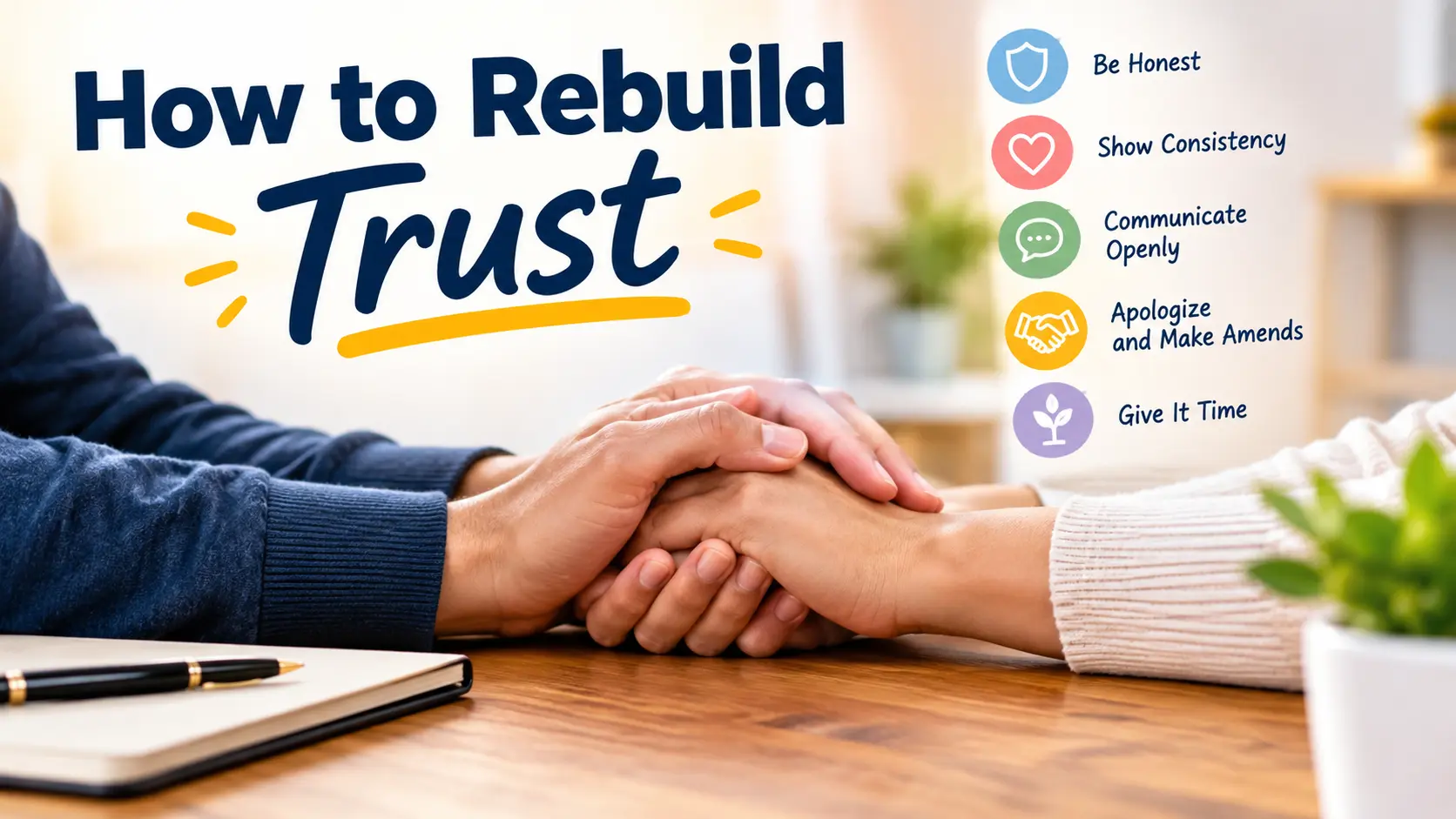
To rebuild trust, acknowledge what happened, take responsibility, communicate honestly, set clear boundaries, and show consistent change over time.
Trust rarely returns because of one apology or promise. It grows through repeated experiences that demonstrate honesty, reliability, respect, and emotional safety.
Key Takeaways
- Trust is rebuilt through consistent behavior, not words alone.
- The person who broke the trust needs to accept responsibility without making excuses.
- The hurt person needs space to express feelings and establish reasonable boundaries.
- Forgiveness does not have to happen immediately, and it does not automatically mean forgetting.
- If trust continues to be broken or the relationship involves fear, control, or abuse, safety should come before relationship repair.
1. Understand What Broke the Trust
Before you can rebuild trust, you need to understand exactly what damaged it.
Trust can be broken by many things, including lying, cheating, hiding information, breaking promises, financial dishonesty, repeated disappointment, or failing to be there when someone needed you.
Sometimes the problem is one major event. Other times, trust disappears slowly after months or years of small disappointments.
Identify the specific breach
Avoid using vague statements such as “You ruined everything.”
Instead, identify what actually happened.
For example:
“You told me the truth would always come first, but I found out that you hid this from me.”
Being specific makes it easier to understand what needs to change.
Talk about its impact
The person who was hurt may need to explain how the event affected their sense of safety, confidence, or connection.
The goal is not to repeatedly punish someone for the mistake. The goal is to understand the damage so both people know what they are trying to repair.
2. Take Full Responsibility
If you were the person who broke the trust, responsibility is one of the most important starting points.
A sincere apology should acknowledge what you did, recognize its impact, and avoid shifting blame.
Instead of:
“I’m sorry, but you also made me do it.”
Try:
“I understand that what I did hurt you, and I take responsibility for it.”
An apology becomes much more meaningful when it is followed by changed behavior.
Research on trust repair has also found that responses to trust violations can matter, with apology playing a different role from simply denying the problem.
Avoid excuses and blame
Explaining why something happened can be useful later, but explanations should not become excuses.
There is an important difference between understanding a behavior and using circumstances to avoid responsibility.
3. Be Honest and Transparent
When trust has been damaged by dishonesty, additional secrecy can make recovery harder.
Honesty means telling the truth even when the truth is uncomfortable.
That may include being open about:
- Where you stand emotionally
- What happened
- What you intend to change
- Important decisions
- Broken commitments
- Concerns that could affect the relationship
Transparency should also have reasonable boundaries. Rebuilding trust does not automatically mean one person must surrender every aspect of their privacy forever.
The goal is to create enough openness for the relationship to become predictable and safe again.
4. Set Clear Boundaries and Expectations
Trust becomes difficult to rebuild when neither person knows what the new rules are.
Talk openly about what needs to change.
For example:
| Trust Problem | Possible Repair |
|---|---|
| Repeated broken promises | Make fewer promises and consistently keep them |
| Hiding important information | Agree to communicate important changes promptly |
| Infidelity | Establish clear relationship boundaries |
| Financial dishonesty | Create agreed-upon financial transparency |
| Poor communication | Schedule regular check-ins |
| Repeated disrespect | Establish clear communication limits |
Boundaries should be specific enough that both people understand them.
Cleveland Clinic similarly highlights expectations, accountability, healthy boundaries, and ongoing positive behavior as parts of rebuilding trust.
Make expectations realistic
A boundary should describe what you will accept or do, rather than becoming a tool for controlling another person.
Healthy expectations create clarity. Unrealistic demands can create another source of conflict.
5. Rebuild Trust Through Consistent Actions
This is where rebuilding trust becomes real.
Someone may say, “You can trust me again,” but trust usually returns through repeated experiences that support those words.
Keep the small promises.
Show up when you say you will.
Tell the truth when it would be easier to hide something.
Follow through on agreed changes.
Do not expect one grand romantic gesture, expensive gift, or emotional conversation to erase months or years of damaged trust.
Small reliable actions repeated over time can be more meaningful.
The Gottman Institute and other relationship-focused sources similarly emphasize that trustworthiness is demonstrated through behavior and repeated reliability rather than words alone.
6. Communicate Without Becoming Defensive
Rebuilding trust often requires difficult conversations.
The hurt person may have questions, anger, sadness, or uncertainty. The person who caused the damage may feel guilt, embarrassment, or frustration.
Both reactions can make communication difficult.
Try to listen before trying to defend yourself.
Instead of immediately saying:
“That’s not what I meant.”
Try:
“I understand why it looked that way. Tell me what you need me to understand.”
Listening does not mean agreeing with every accusation. It means giving the other person an opportunity to explain their experience.
The Gottman approach specifically emphasizes listening, discussing feelings without blame, accountability, and creating a plan to prevent future breaches.
7. Give the Healing Process Time
One of the biggest mistakes people make is expecting trust to return immediately after an apology.
It may not.
The person who was hurt may still feel uncertain even after seeing genuine changes. A reminder, argument, or similar situation can bring old emotions back.
That does not necessarily mean progress has failed.
Trust can develop unevenly.
Some days may feel much better than others.
Cleveland Clinic notes that restoring trust can take weeks, months, or even years depending on the circumstances.
Avoid forcing forgiveness
Forgiveness and trust are related, but they are not the same thing.
Someone can forgive another person while still needing boundaries.
Likewise, someone can decide to continue a relationship while recognizing that trust still needs time to grow.
8. Learn to Trust Again Without Ignoring Red Flags
If you are the person whose trust was broken, rebuilding trust does not mean pretending nothing happened.
It is reasonable to pay attention to whether behavior is actually changing.
Ask yourself:
- Are their words matching their actions?
- Are they accepting responsibility?
- Are they respecting agreed boundaries?
- Are the same behaviors happening repeatedly?
- Do you have evidence of meaningful change?
- Are you feeling safer because of what they do, rather than simply what they promise?
There is also a difference between healthy caution and constantly searching for evidence of betrayal.
The goal is not to ignore warning signs. It is to gradually determine whether current evidence supports greater trust.
Previous betrayal can also affect how people respond to future relationships and trust, which helps explain why rebuilding confidence may take time.
9. Consider Professional Help When Needed
Some trust problems are difficult to solve through conversations alone.
Consider working with a licensed therapist or qualified relationship professional when:
- The same conflict keeps repeating.
- Infidelity has seriously damaged the relationship.
- Communication regularly becomes hostile.
- One or both people cannot move past the betrayal.
- You cannot agree on boundaries.
- The situation is creating significant emotional distress.
Professional support can provide a structured environment for difficult conversations and help people understand destructive communication patterns.
The American Psychological Association describes therapeutic approaches that can help couples manage conflict and begin restoring trust after infidelity.
Important: If a relationship involves physical violence, threats, coercive control, or fear for your safety, rebuilding trust should not be treated as the first priority. Seek appropriate safety and professional support.
Can Trust Be Rebuilt After Cheating or Major Betrayal?
Yes, trust can sometimes be rebuilt after serious betrayal, but there is no guarantee that every relationship will return to what it was before.
The process generally requires more than saying “I’m sorry.”
The person who caused the betrayal needs to acknowledge what happened, answer important questions honestly, respect boundaries, and demonstrate meaningful behavioral change.
The hurt partner may also need time to process anger, grief, uncertainty, and questions about the relationship.
The American Psychological Association notes that infidelity can seriously disrupt trust and security, while relationship-focused treatment can help couples address the resulting conflict and work toward more secure attachment.
The goal is not necessarily to recreate the exact relationship you had before.
Sometimes rebuilding means creating a relationship with clearer expectations, stronger communication, and more reliable behavior than before.
Frequently Asked Questions
Can trust be rebuilt after it is broken?
Yes, trust can sometimes be rebuilt when the people involved are willing to acknowledge the problem, communicate honestly, respect boundaries, and demonstrate consistent change. However, rebuilding trust takes time, and the outcome depends on the nature of the betrayal and whether the behavior that caused the damage actually changes.
How long does it take to rebuild trust?
There is no universal timeline. Minor breaches may improve relatively quickly, while serious betrayal can require much longer. The process may take weeks, months, or even years. What matters most is sustained behavior rather than reaching an arbitrary deadline.
How do you rebuild trust after lying?
Start by telling the truth, taking responsibility, and stopping the pattern of secrecy. Explain what happened without making excuses, answer reasonable questions honestly, and then demonstrate reliability through consistent actions. Repeated honesty over time is more meaningful than promising that you will never lie again.
Can you rebuild trust after cheating?
It can be possible, but rebuilding after infidelity is often especially difficult. It generally requires accountability, honesty, clear boundaries, patience, and sustained behavioral change. Couples may also benefit from professional support when conversations repeatedly become overwhelming or unproductive.
Does forgiveness mean trusting someone again?
No. Forgiveness and trust are separate decisions. You may forgive someone while still maintaining boundaries and waiting to see whether their behavior changes. Trust usually develops from repeated experiences of reliability and honesty.
What is the fastest way to rebuild trust?
There is no reliable shortcut. The most useful approach is to stop the behavior that damaged trust, acknowledge the harm, communicate honestly, establish clear expectations, and consistently follow through. Trying to rush the process can create additional pressure rather than genuine trust.
Conclusion
Learning how to rebuild trust is less about finding the perfect words and more about creating a consistent pattern of trustworthy behavior.
Start by understanding what went wrong. Take responsibility when you caused the damage. Be honest, communicate clearly, establish reasonable boundaries, and follow through on your commitments.
If you were the person who was hurt, give yourself permission to move gradually. You do not have to ignore red flags or force yourself to trust before you feel ready.
Most importantly, remember that trust is built through repeated experiences. One apology can open the door, but consistent actions are what help keep it open.

I’m Moja Spark, the creator of Punvio.com, where I share my expert-level humor, puns, and witty content to make your day brighter and more fun. Explore creative wordplay, clever jokes, and laugh-worthy ideas crafted by me